Barriers to Communication and How to Overcome Them
Learn the main barriers to communication, why they happen, and practical strategies to overcome them at work and across languages.
Written by
 Mathias Michel
You send a short message to a colleague: “Can you handle the client update by Friday?” You mean, “Please confirm whether you have capacity, then prepare a draft.” Your colleague reads it as a firm assignment, assumes Friday means the end of the workday, and starts working from an outdated document. By the time you discover the mismatch, both of you feel frustrated, even though neither person intended to create a problem.
This is how barriers to communication usually appear. They rarely arrive as one dramatic obstacle. Noise, unclear wording, cultural expectations, stress, bias, inaccessible tools, and overloaded schedules combine to change what a person sends, hears, or feels safe enough to say. Effective communication isn't just a matter of choosing better words. It's a shared system that must help people exchange meaning, check understanding, and participate.
Why Communication Breaks Down More Often Than You Think
A manager posts, “Please send the numbers soon,” during a crowded workday. One colleague treats “soon” as before lunch, another reads it as the end of the day, and a third cannot find the latest figures because they are stored in a different system. Each person may be acting reasonably within their own context. The breakdown comes from several system failures arriving together.
A message can use correct grammar and still miss its purpose. Meaning changes when people lack shared context, work under time pressure, process too much information, or worry that an accent or wording will make them sound less capable. For non-native speakers, accent anxiety can make a simple clarification feel risky. They may remain silent, while fluent speakers mistake silence for agreement.
Communication access also extends beyond language. Among approximately 8 million Canadians with disabilities aged 15 and over in 2022, about 3.8 million people, or 48%, reported at least one accessibility barrier when communicating in several situations during the previous year, according to Zoom's workplace communication statistics overview. Access can affect services, digital interfaces, participation, and relationships.
The five families behind everyday confusion
Everyday breakdowns usually involve several of these families:
- Physical and environmental barriers: Noise, distance, poor lighting, fatigue, or a meeting room that makes hearing and concentration difficult.
- Semantic and language barriers: Jargon, vague requests, unfamiliar expressions, translation gaps, or words with different meanings.
- Cultural barriers: Different expectations about directness, silence, hierarchy, disagreement, politeness, or feedback.
- Emotional and psychological barriers: Fear, anxiety, distrust, embarrassment, or concern that speaking up will bring negative consequences.
- Technological and organizational barriers: Fragmented tools, missing information, unclear ownership, overloaded channels, and messages sent through the wrong medium.
These families interact. A remote employee may miss an update because it disappears in a busy chat. A heavy workload then discourages a question, while status differences make the manager's quick instruction seem final. What looks like inattention may reflect channel design, information overload, bias, and limited psychological safety.
Communication is a shared responsibility
The sender creates the initial message, but the receiver works within the surrounding conditions. Clear wording cannot define an unclear deadline, and a confident speaker cannot compensate for poor sound or inaccessible materials.
A more useful question is, “Where did meaning become distorted?” It directs attention to timing, environment, tools, mental models, workload, and behavior rather than blaming one person. That shift helps teams make clarification normal, choose better channels, and create conditions in which people can participate.
How Communication Works and Where It Gets Blocked
A simple communication model works like a radio transmission. One person creates a message, a channel carries it, another person interprets it, and feedback confirms whether the intended meaning arrived.
The signal from sender to receiver
The process has four basic stages:
- Encoding: The sender turns an idea into words, images, gestures, or a written format.
- Channel: The message travels through speech, email, chat, a document, a call, or a meeting.
- Decoding: The receiver interprets the message using language, experience, attention, and expectations.
- Feedback: The receiver asks, summarizes, confirms, or acts in a way that reveals what they understood.
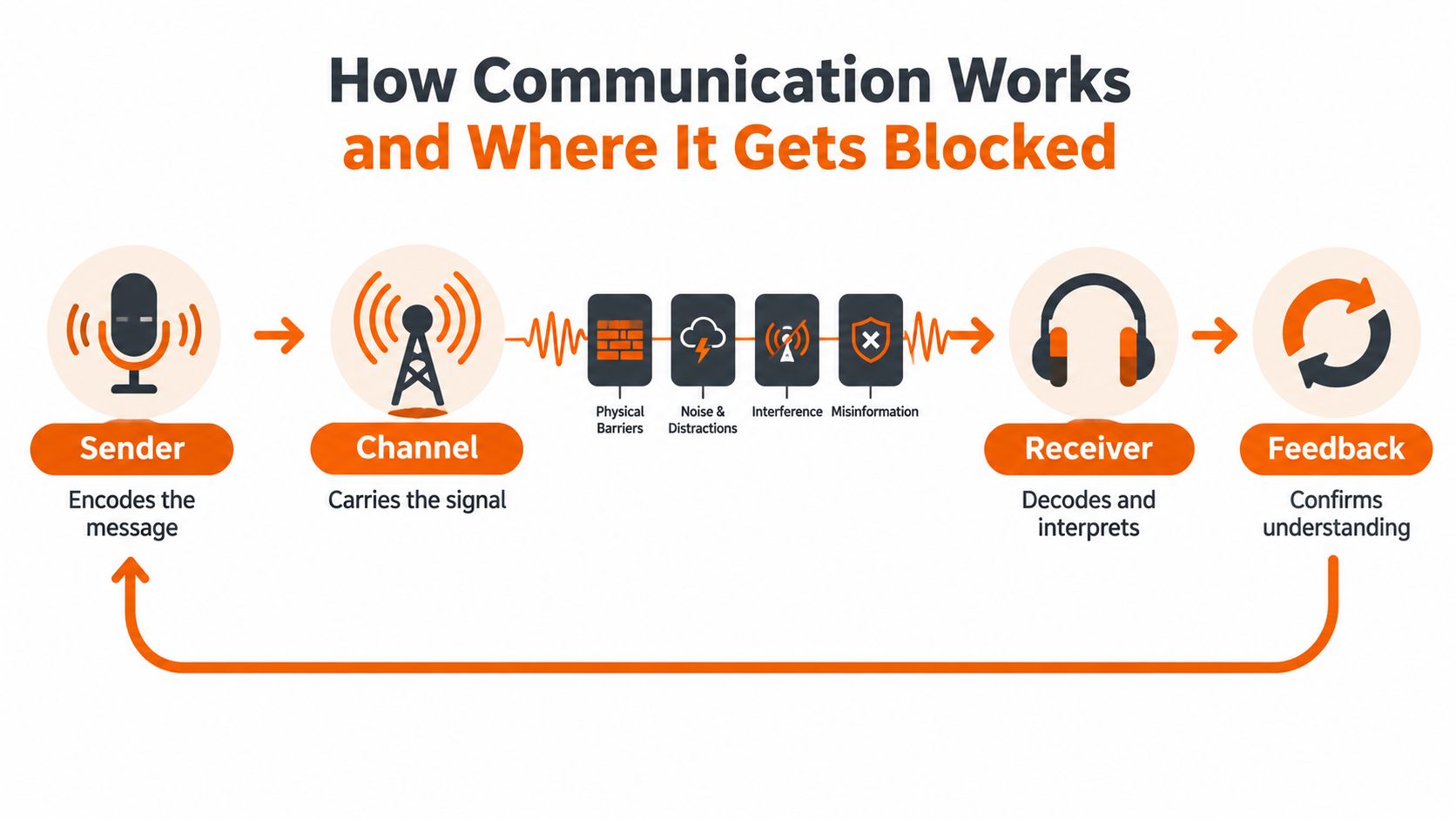
Noise can enter at any point. The sender may encode an incomplete thought. The channel may be noisy or poorly chosen. The receiver may decode the message while distracted, tired, or worried. Feedback may never happen because the message appears too obvious to question.
Noise is anything that changes, hides, competes with, or distorts the meaning moving between people.
Why feedback matters
Without feedback, the sender sees only delivery, not understanding. “I sent the document” confirms transmission. “I'll use the approved template, send a draft to the client contact, and flag any missing figures before Friday afternoon” confirms interpretation.
This is why communication skills include listening, questioning, summarizing, and adapting. Teams looking for practice with these behaviors can use resources such as Corporate Challenge Events communication skills, particularly when they want to turn abstract advice into observable team habits.
Written communication needs the same discipline. Before sending an email, make the action, owner, deadline, and relevant context visible. Guidance on business email etiquette can help writers review tone and structure before a message enters a busy workflow.
A useful diagnostic is to trace the message backward:
- What did the sender intend?
- What exact words or signals did they use?
- Which channel carried them?
- What did the receiver need to know in order to interpret them?
- What feedback would have exposed a misunderstanding early?
This model prevents a common mistake. People often try to fix decoding problems by repeating the same message louder or longer. If the barrier is a missing definition, a poor channel, or fear of asking questions, repetition only sends the same distortion through the system.
The Five Main Types of Barriers to Communication Explained
The classic categories help you name the obstacle before choosing a response. Naming the type doesn't mean that each problem has one isolated cause. It gives you a starting point for investigation.
Physical and environmental barriers
A loud office, weak audio, poor lighting, physical distance, or an uncomfortable room can interrupt the signal before interpretation begins. Someone who keeps asking “Can you repeat that?” may not have a listening problem. The setting may be making listening unnecessarily difficult.
Location also affects participation. Research involving people with speech, voice, language, and hearing problems identified conversation location as a major driver of participation difficulty, with fatigue also reported as a major barrier in the Journal of Speech, Language, and Hearing Research study. A quieter room, an accessible format, or a better meeting time can change whether a person can take part.
Semantic and language barriers
A semantic barrier appears when people attach different meanings to the same words. “Soon,” “sign off,” “production ready,” and “low priority” can sound precise to one person and vague to another. Acronyms, idioms, regional phrases, and technical vocabulary create similar problems.
Language barriers extend beyond translation. UNESCO has reported that language-related barriers exclude about 15% of the world's population from global dialogue, while 360info reported that 40% of the global population lacks access to education in a language they speak or understand, as cited in ZipDo's workplace communication statistics summary. In a team, a fluent speaker may still need plain wording, written context, or time to formulate a response.
Cultural barriers
Culture shapes expectations about interruption, eye contact, disagreement, silence, personal space, and the way people show respect. A direct “I disagree” can signal honesty in one workplace and disrespect in another. A quiet participant may be carefully considering an idea, not showing agreement.
The solution isn't to reduce people to cultural stereotypes. Ask about preferences, explain your own assumptions, and make multiple forms of participation acceptable.
Emotional and psychological barriers
Stress changes attention. Anxiety can make a person monitor every word instead of following the conversation. Anger can turn a neutral comment into an accusation, while distrust can make even a clear explanation feel incomplete.
These barriers often require a pause rather than a better sentence. A person who feels unsafe may need private feedback, preparation time, or a clear invitation to disagree before they can participate fully.
Technological and organizational barriers
A message can fail because it travels through too many tools, reaches the wrong person, or lacks a clear owner. Chat, email, project boards, documents, and meeting notes may each contain part of the context. Employees then spend effort reconstructing the decision instead of acting on it.
Organizational structure adds another layer. When authority, responsibility, or escalation paths are unclear, people delay questions or send information through informal routes. The resulting silence can look like agreement, even when nobody knows what happens next.
<iframe width="100%" style="aspect-ratio: 16 / 9;" src="https://www.youtube.com/embed/slq1nAhZuqE" frameborder="0" allow="autoplay; encrypted-media" allowfullscreen></iframe>Real World Examples That Make Each Barrier Tangible
A category becomes useful when you can recognize it in a real moment. The same sentence may succeed in one setting and fail in another because the environment, relationship, or shared context has changed.
A message lost in the room
In an open office, a manager explains a new process while nearby colleagues talk and phones ring. An employee hears the deadline but misses the exception. In a quiet one-to-one conversation, the same explanation might be easy to follow. The barrier isn't motivation. It's the channel and environment.

A polished email with different meanings
A product lead writes, “Please close the remaining issues before launch.” A developer interprets “close” as resolve every ticket. A marketer assumes it means identify which tickets can wait. The wording sounds professional, but it doesn't define the action or the acceptance standard.
A stronger version might say: “By Thursday, label each open ticket as required for launch, acceptable to defer, or blocked. Add the reason and owner to the project board.” Specificity reduces the amount of interpretation the receiver must supply.
Feedback across cultures
A manager says, “You should be more confident in meetings.” In one context, that may feel like useful encouragement. In another, the employee may hear a criticism with no practical guidance and may avoid future contributions. The manager can make the message more actionable by naming the behavior: “In the next meeting, please present your recommendation first, then explain the two reasons behind it.”
People who want more practice with meeting language can explore an Englify business English course as one way to rehearse common phrases before a high-pressure discussion.
Emotion changes what people hear
During a tense incident review, someone says, “This should have been caught earlier.” The speaker may be describing a process gap. A tired colleague may hear blame and stop sharing information. Replacing judgment with curiosity, such as “Where did the checking process fail?” keeps attention on the system and makes a fuller answer more likely.
Fragmented tools hide the decision
A remote team discusses a launch in chat, records an action in a meeting document, and updates the task board later. One person sees the old deadline, another sees the new owner, and a third never sees the decision. The words weren't necessarily unclear. The communication system lacked one dependable place for the current version.
Hidden Barriers Most Guides Miss at Work
Many guides treat communication problems as vocabulary problems. That advice misses what happens when people have little time to read, no space to clarify, and a social reason to stay quiet.
A 2025 global employee communications report found that the leading workplace barriers included lack of time and capacity, change fatigue, poor people-manager communication, unclear direction from senior leaders, and poor leadership communication. Information overload and heavy workloads limited time to check communications for 62% of respondents, while limited digital access affected 31%, according to Gallagher's 2025 global employee communications report.
Overload turns clear messages into missed messages
A person can understand your email and still fail to act because it arrived among too many competing demands. Constant switching also reduces the chance that someone will notice a missing attachment, verify a deadline, or ask what “done” means.
This is an operational barrier, not a sentence-quality issue. Teams need fewer competing channels, visible priorities, short summaries, and protected time for messages that require judgment.
Accent anxiety suppresses participation
Accent anxiety creates a different kind of failure. The listener may understand the speaker perfectly, but the speaker may spend so much effort monitoring pronunciation that they avoid contributing, shorten their explanation, or remain silent.
A 2025 U.S. survey of 2,000 workers found that one in five felt judged for their accent, 25% reported safety risks connected to language barriers, only 24% said their workplace offered language training or support, and nearly a quarter of higher earners spent more than two hours a day worrying about how they speak, as reported by Learning News. These findings challenge the idea that employees need better English. Bias and self-monitoring can restrict participation even when comprehension is strong.
| Barrier focus | Classic view | Hidden reality |
|---|---|---|
| Language | Someone lacks vocabulary | A fluent speaker may fear judgment |
| Attention | Someone isn't listening | Workload leaves no capacity to process |
| Participation | Someone has no ideas | Status or accent anxiety discourages speaking |
| Digital access | A tool is available | The tool may be inaccessible or fragmented |
| Clarity | The writer needs better grammar | The organization may need better priorities |
A 2026 clinical communication review grouped recurring obstacles into linguistic, cultural, psychological, and mismatched mental-model classes, showing that they interact across the care encounter rather than operating as isolated terminology problems, as described in the JMIR review. The same principle applies at work. Better wording helps, but it can't replace trust, shared expectations, usable channels, and reasonable cognitive demands.
For distributed teams, remote work communication guidance can support clearer channel choices and written follow-up. The deeper lesson is that inclusion depends on designing communication so people don't have to overcome avoidable obstacles before their ideas can be heard.
Practical Strategies to Overcome Barriers to Communication
Start with diagnosis, then match the response to the barrier. Don't send a longer message to solve a noisy room, and don't schedule another meeting to solve a vague sentence.
Make meaning easy to retrieve
Replace abstract requests with an action, owner, deadline, and definition of completion.
- Before: “Can you review this soon?”
- After: “Please check the figures in sections two and three, add comments in the document, and reply by Thursday at noon.”
- Before: “Let's take this offline.”
- After: “Maria and I will resolve the open question in a private call today and post the decision in the project channel.”
Use plain language for mixed-language teams. Define necessary technical terms, avoid idioms when precision matters, and ask the receiver to summarize the next step. That isn't a test. It's a feedback loop.
Design for the listener
Ask what the receiver needs to understand and act. Provide captions or written notes when hearing access matters, move sensitive feedback to a private setting, and give people a moment to respond rather than rewarding whoever speaks fastest.
For cross-cultural work, state the communication norm instead of assuming it. Say, “I prefer direct disagreement, and it won't affect how I evaluate the idea,” then demonstrate that behavior consistently.
Reduce operational friction
Choose one source of truth for decisions. Use chat for quick coordination, a task system for ownership and status, and a document for durable context. Keep important messages short at the top, with supporting detail below.
Before a meeting, send the purpose and decision required. During it, record owners and dates. After it, publish a concise summary. These habits reduce the need for employees to search across tools while juggling other work.
Use tools without outsourcing judgment
A writing assistant can help a non-native speaker simplify a sentence, adjust tone, or translate selected text, but the sender still needs to verify meaning and cultural fit. RewriteBar is one macOS option that works in apps with text input and supports grammar, tone, clarity, simplification, rephrasing, and translation workflows.
People who communicate with prospects can apply the same discipline to cold callers, especially when scripts need to sound natural rather than mechanical. For broader habits, review these professional communication skills and choose one behavior to practice repeatedly.
Building Clearer Communication Habits for the Long Term
A rushed manager posts a vague request in chat, a colleague reads it between meetings, and both leave with different deadlines. Clarity improves when teams design communication around the receiver, the channel, and a way to confirm meaning. That makes barriers a system problem involving environment, overload, bias, and mental models, rather than a language flaw alone.
Use a repeatable loop:
- State the point: Lead with the decision, request, or concern.
- Add the context: Include only what the receiver needs to act.
- Check the interpretation: Ask for a summary, question, or visible next step.
- Adjust the system: If the same failure returns, change the channel, timing, environment, or wording.
This loop also supports inclusion. As noted earlier, communication accessibility barriers affect participation and access to services, not only workplace etiquette. A clear channel, readable format, and patient confirmation can give people with disabilities and non-native speakers a fairer chance to understand and contribute. Accent anxiety often grows when rushed listeners treat unfamiliar pronunciation as evidence of weak ideas, so confirmation should test meaning, not identity.
Try one change today. Rewrite a request with a specific action and deadline, choose the channel deliberately, and invite confirmation. Repeated small adjustments make communication more dependable than asking everyone to “be clearer.”
RewriteBar helps reduce unclear wording, adjust tone, simplify sentences, and translate selected text in macOS apps. Visit RewriteBar for details.

More to read
How to Write Professionally: Your 2026 Guide
Master how to write professionally. This 2026 guide covers tone, structure for emails, reports, grammar, & tools to boost your clarity & impact.
Professional Communication Skills That Actually Work
Build professional communication skills that get results at work. Clear frameworks, real examples, and practical exercises for every situation.
Write Your Company Mission Statement: 2026 Guide
Craft a compelling company mission statement for 2026. Get examples, templates, and steps to guide your team and avoid pitfalls.
Tags
Written by
Mathias MichelPublished
September 23, 2026