How to Write a 400 Word Essay (Even if You Hate Writing)
Write a stronger 400 word essay with a clear 4-paragraph plan, realistic word counts, and examples that show what 400 words looks like.
Written by
 Mathias Michel
You sit down to write a 400 word essay and it feels insultingly small. Then the blank page wins anyway.
That’s the trap. Short assignments look easier than long ones, but they’re usually less forgiving. You can hide weak thinking inside a long draft. You can’t hide it inside 400 words. Every sentence has to earn its place.
That’s also why this format is worth learning. If you can explain one idea clearly in a tight space, you can write a cleaner project brief, a sharper application essay, a better client email, and a post people finish. Students need that skill. So do developers, marketers, founders, and anyone who writes at work.
How I Evaluated What Makes a Strong 400 Word Essay
Common questions before drafting include how long 400 words look on the page, how many paragraphs fit comfortably, and what a real example includes when space is tight. When I review short essays, I judge them on five simple criteria: a clear thesis, distinct paragraph jobs, realistic word budgeting, enough explanation to prove the point, and no filler pretending to be sophistication.
I also checked whether the sample essays stay near the target length instead of just being labeled “short.” That sounds obvious, but a lot of online examples drift far past the limit or use oversized introductions that would cost points in a real class. For structure guidance, I leaned on practical university writing-center advice rather than made-up precision. For example, the UNC Writing Center on thesis statements emphasizes that a thesis should make a claim the paper can support, which matters even more when you only have a few paragraphs to work with.
One more editorial note: when a draft truly feels like 400 words, it usually reads with forward motion. There’s no long runway, no repeated setup, and no paragraph that exists just because the writer felt every essay needed one.
Why Mastering the 400 Word Essay Matters
A common practical question is scale. In practice, 400 words usually means 3 to 5 paragraphs, depending on the assignment. On the page, that is often about one page single-spaced or around one and a half pages double-spaced in a standard 12-point font with normal margins. When I skim a student draft, I can usually tell within seconds whether it is really in range: a genuine 400-word piece looks compact, with little room for scene-setting or repetition. For a simple historical overview of how reflective academic samples are framed online, this essay sample overview is one example of the kind of compact model students often compare against.

A useful mental picture is this:
- Introduction: about 50-70 words
- Body paragraph 1: about 110-140 words
- Body paragraph 2: about 110-140 words
- Conclusion: about 40-60 words
That won’t fit every prompt, but it gives you a realistic frame. If your first paragraph is already 130 words, the essay is probably front-loaded. If each body paragraph is only 60 words, the draft probably names points without developing them.
The format matters because it tests a skill that transfers well beyond classwork: selecting the one idea worth proving and giving it just enough support. A short essay is small enough to expose weak structure fast and useful enough to sharpen broader clarity in writing.
What 400 words should feel like while you read
A good short essay feels finished, not cramped. The reader should be able to identify the main claim in the opening, follow one or two supporting moves in the middle, and reach a conclusion that adds perspective rather than repeating the thesis. In my experience, the weakest drafts are not usually too short on information; they are too crowded with half-developed ideas.
Typical paragraph counts by assignment type
If you are trying to picture the shape before writing, these are the most common setups:
- 3 paragraphs: intro, one longer body paragraph, conclusion
- 4 paragraphs: intro, two body paragraphs, conclusion
- 5 paragraphs: intro, three short body paragraphs, conclusion
The 4-paragraph version is the safest default for most school prompts. It gives you enough room to make a claim, explain it twice, and close cleanly.
The Blueprint for a Perfect 400 Word Essay
Most weak short essays fail before the first sentence. The writer starts drafting without a shape.
The fix is not a complicated formula. It is a plan for where the limited space goes. Harvard’s Expository Writing guide recommends outlining around the main claim and the function of each paragraph, which is exactly the right approach here: every paragraph needs a job before you start polishing sentences.
Start with a realistic paragraph plan
For a 400-word assignment, these three structures cover most situations:
Option 1: 3 paragraphs for a reflection or response
- Intro with thesis: 60-80 words
- One developed body paragraph: 240-280 words
- Conclusion: 40-60 words
Use this when the assignment asks for a personal response, a brief reflection, or a tightly focused argument with one central line of reasoning. One longer body paragraph works when all your evidence supports the same point and splitting it would create choppy repetition.
Option 2: 4 paragraphs for a standard academic answer
- Intro with thesis: 50-70 words
- Body paragraph 1: 110-130 words
- Body paragraph 2: 110-130 words
- Conclusion: 40-60 words
This is the best default for most prompts. It gives each support point enough room to include a claim, an example, and a sentence of explanation.
Option 3: 5 paragraphs for compare/contrast or multi-part prompts
- Intro with thesis: 50-60 words
- Body paragraph 1: 80-95 words
- Body paragraph 2: 80-95 words
- Body paragraph 3: 80-95 words
- Conclusion: 35-45 words
Use this only if the prompt clearly demands three separate points. In 400 words, five paragraphs can work, but only if each body paragraph stays extremely focused.
Mini outline with approximate word counts
Here is a simple model for a general academic topic: Should first-year college students be required to take a writing course?
- Paragraph 1 — 60 words: Introduce the issue and state the thesis: first-year writing should be required because it improves academic performance, helps students communicate across disciplines, and builds revision habits early.
- Paragraph 2 — 120 words: Explain how writing courses help students make clearer arguments and read assignments more carefully.
- Paragraph 3 — 120 words: Show how the skill carries into lab reports, discussion posts, presentations, and professional communication.
- Paragraph 4 — 50 words: Conclude by arguing that the course is not just remedial; it is foundational.
That outline works because each paragraph earns space. Nothing is included just because it sounds nice.
How to decide what belongs in only 400 words
When space is tight, ask four questions about every sentence:
- Does it state the claim?
- Does it support the claim with an example or explanation?
- Does it connect the evidence back to the point?
- If I cut it, would the argument weaken?
If the answer to the fourth question is no, the sentence is expendable. I use that test constantly when editing short drafts, and it catches most throat-clearing instantly.
When one longer body paragraph makes sense
One longer body paragraph works best when the assignment is reflective, narrative, or centered on a single insight that unfolds step by step. Two shorter body paragraphs make more sense when you have two distinct reasons, two examples, or a claim-and-counterpoint structure. The wrong choice usually shows up as either a bloated middle paragraph or two tiny paragraphs that feel unfinished. Sentence variety matters too, but in short essays it should serve clarity; this discussion of lexical diversity and student essay quality is useful background on why vocabulary range alone does not rescue weak structure.
What doesn’t work
- Big introductions that spend too long defining obvious terms
- Body paragraphs with multiple claims fighting for space
- Conclusions that repeat sentences instead of sharpening the takeaway
- Decorative vocabulary that sounds academic but says little
If you need a refresher on broader general principles of essay writing, that guide is useful because it focuses on argument flow rather than filler.
A solid blueprint gives you something better than motivation. It gives you limits. Those limits make drafting faster.
From Outline to First Draft Efficiently
The first draft should be fast and slightly messy. If you try to perfect every sentence while drafting, you’ll stall.
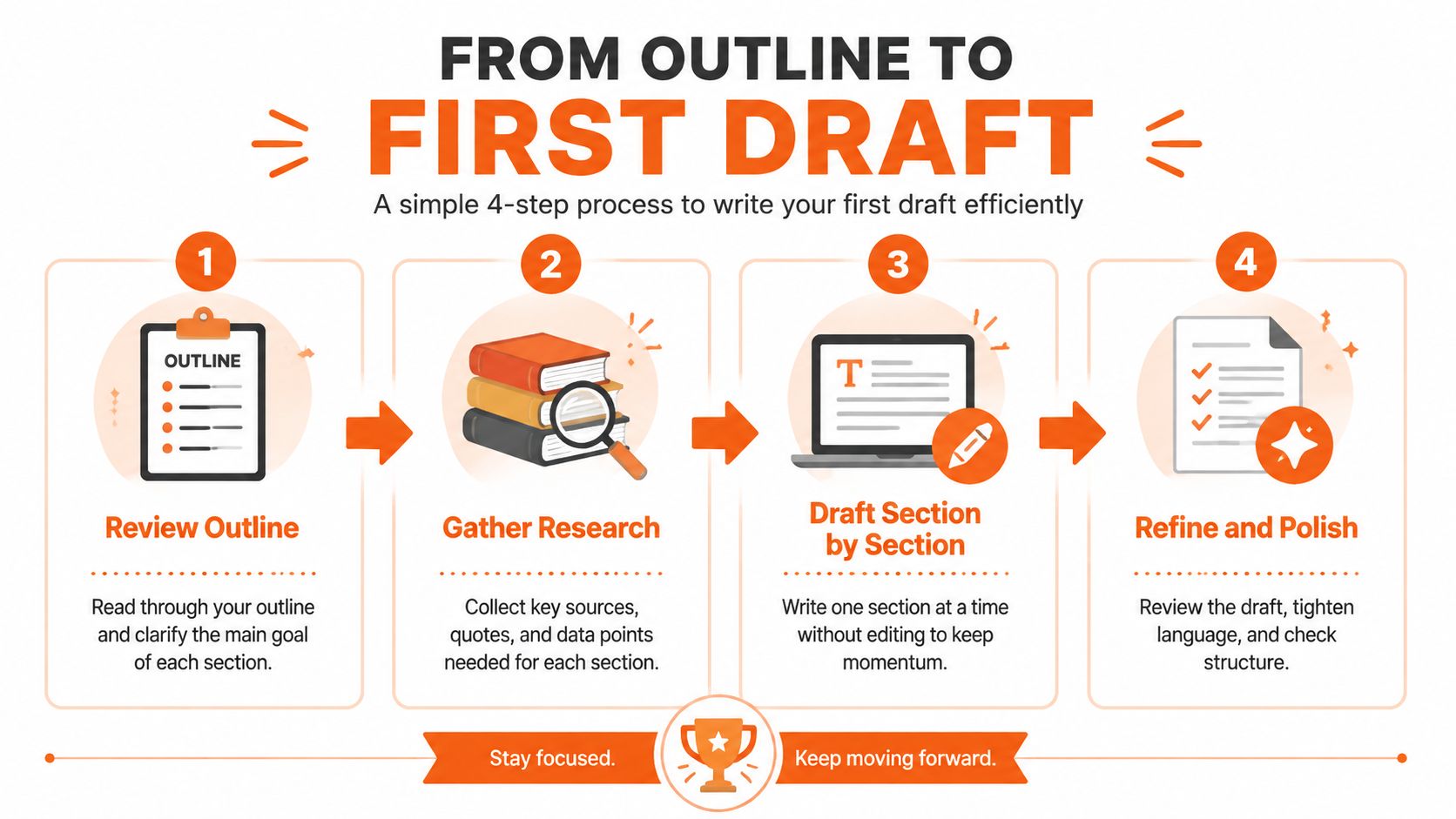
Start with raw material. Bullet points are enough.
For writers outside school, this format maps well to real work. LinkedIn posts under 400 words garner 55% more engagement globally, while software specs capped at 400 words reduce miscommunication errors by 28% in developer teams, based on this summary of short-format writing performance. That matters because the drafting habit you build for essays is the same habit you use when writing product notes, landing page copy, or internal updates.
Draft in layers, not in order
You don’t need to begin with the introduction. In fact, many writers do better if they don’t.
Try this process:
- Body first
Write one sentence for each core point. Expand those sentences into compact paragraphs. - Conclusion second
Once the body exists, it’s easier to say what the essay proved. - Introduction last
Now you know what you’re introducing.
That order reduces a lot of false starts.
Use an outline that is almost embarrassingly simple
A useful outline for a 400 word essay often looks like this:
- Main claim
- Reason one
- Reason two
- Why it matters
That’s enough. You’re not building a dissertation. You’re building a small, coherent argument.
Writers who struggle with structure can also borrow ideas from long-form planning. This guide on how to outline a book is aimed at bigger projects, but the principle scales down well. Break the work into parts with a clear function, then draft one part at a time.
Lower the friction on the first pass
A lot of students and busy professionals already know what they want to say. Typing is just slower than thinking.
If that’s you, dictation helps. Speaking rough ideas out loud is often faster than staring at the cursor and second-guessing every line. This practical guide to how to use dictation on a Mac is worth trying if your bottleneck is momentum, not ideas.
Working habit: Draft sentences you can fix later. Don’t pause to polish a paragraph that may get cut.
What efficient drafting looks like in real life
A student writing an application response might jot down:
- moved between schools
- learned to adapt socially
- stopped treating difference as a problem
- now volunteer with new students
A developer writing a short technical reflection might jot down:
- spec was too vague
- team interpreted requirement differently
- rewrite fixed scope confusion
- concise writing saved rework
Those bullets are enough to start. The first draft’s job isn’t elegance. It’s momentum.
A 400 Word Essay Example in Action
Abstract advice only gets you so far. It helps more to see a finished piece and examine why it works.
Before the sample, here is what to notice. A useful model is not just “about 400 words.” It should also show a clear paragraph pattern. The first essay below is roughly 400 words, uses 5 paragraphs, and follows a straightforward sequence: setup, interpretation, application, broader meaning, and conclusion. That is why it works as a model rather than just a short piece of writing.
Here’s a sample 400 word essay on a topic many applicants mishandle. One common mistake is exaggerating minor hardship. That backfires because admissions readers are alert to “manufactured adversity” and want evidence that an experience shaped the writer’s worldview, as explained in this discussion of authenticity in diversity essays. If you want a broader sense of how strict word limits change essay planning across assignment types, this guide has more from Humantext.pro.
Sample essay
Prompt: Describe an experience that shaped your perspective and would help you contribute to a learning community.
Growing up, I thought difference was something I had to manage internally. I changed schools more than once, moved between language environments, and learned early that fitting in often meant speaking less. At first, I treated adaptation as a private survival skill. Over time, I realized it changed how I listen, how I notice exclusion, and how I work with people who don’t immediately feel at ease in a room.
The most important shift was not hardship itself. It was perspective. Moving between communities taught me that confidence is often mistaken for belonging. Some students speak first because they feel secure. Others stay silent because they are still translating, socially or mentally, what the room expects from them. Once I understood that, I stopped judging participation at surface level. I became more attentive to who was left out of conversations and why.
That awareness shaped my role in group settings. In class projects, I often became the person who checked whether everyone understood the assignment before the group rushed ahead. I learned to ask simpler questions, summarize decisions clearly, and create space for quieter people to contribute. Those habits didn’t come from formal leadership positions. They came from knowing how easy it is to disappear when a group moves too fast.
This perspective also changed how I see diversity. I don’t think it is best described as a list of visible differences or difficult experiences. What matters is whether an experience changed how a person interprets other people’s behavior, assumptions, and needs. For me, moving across settings made me more patient, more observant, and less likely to assume that silence means disengagement.
I would bring that perspective to a learning community by contributing the kind of attention that helps groups function better. I notice who has not been heard. I value clarity because I know confusion can look like indifference from the outside. Most of all, I understand that inclusion is not created by good intentions alone. It is created when someone takes responsibility for making participation easier for others.
Second example: a general academic model
Prompt: Should colleges require first-year students to take a writing course?
Colleges should require first-year writing courses because writing is not a narrow humanities skill. It is the tool students use to think through ideas, respond to readings, and communicate clearly across subjects. Even strong high school writers often arrive with uneven habits, especially when assignments become more analytical and evidence-based.
A required writing course helps students learn how to make claims that are specific enough to defend. In many first-year classes, students lose points not because they lack ideas but because their points stay vague or unsupported. Writing instruction gives them practice in forming a thesis, selecting evidence, and explaining why that evidence matters.
The benefit also extends beyond English classes. Science students need organized lab reports, business students need concise proposals, and social science students need clear argumentation. When students learn early how to structure a paragraph and revise for precision, that skill improves work in multiple courses rather than in just one department.
For that reason, a writing course should be treated as foundational. It helps students adapt to college-level expectations and gives them a communication skill they will keep using long after the course ends.
Annotated breakdown: what to look for in a strong example
In both examples, the thesis appears in the opening paragraph, not halfway through the piece. The middle paragraphs then do the heavy lifting: they provide either evidence, interpretation, or concrete application. The conclusions work because they extend the point rather than copying the first paragraph.
When I show sample essays to students, this is the pattern they miss most often: the body is where the explanation belongs. A short essay still needs cause-and-effect thinking. Naming an example is not enough; the writer has to say what the example proves.
Why the first essay works
The opening succeeds because it avoids melodrama. It doesn’t claim extreme adversity. It identifies a real pattern and names the effect.
“I changed schools more than once, moved between language environments, and learned early that fitting in often meant speaking less.”
That line gives context, pressure, and theme in one move.
Strong choices worth copying
- It focuses on interpretation, not performance
The writer doesn’t try to sound heroic. - It turns experience into behavior
The essay shows how perspective affects action in groups. - It defines contribution concretely
“I notice who has not been heard” is stronger than “I value diversity.”
What admissions readers want: a believable link between experience, perspective, and contribution.
What this sample avoids
It doesn’t inflate ordinary inconvenience into trauma. It also doesn’t hide inside abstraction. That balance matters.
A weaker version would spend the whole essay announcing resilience without showing what changed. This version stays grounded. It answers the practical question behind the prompt: how will this person affect the room once they arrive?
If you’re writing your own 400 word essay, that’s a good standard to use. Don’t ask whether the story sounds impressive enough. Ask whether it changed how you think and act.
Editing Your Essay for Clarity and Impact
Drafting gets the essay written. Editing makes it readable.

The final pass matters because short drafts break in obvious places: they run long, they come up short, or they sound polished while still saying too little. I see the last problem constantly. A 300-word draft often looks clean on the surface, but once you read closely, it has skipped the explanation that would make the argument convincing. The Purdue OWL revision guide is useful here because it separates big-picture revision from sentence-level cleanup. If you want outside support after revising on your own, this overview of why essay editing services matter explains the basic role editing can play in academic success.
If your draft is 450-500 words, cut it down without hurting the argument
Start by cutting in this order:
- Warm-up sentences in the introduction
- Repeated explanation in the body
- Examples that do the same job twice
- Conclusions that restate instead of sharpen
A quick test: highlight the thesis, the best evidence, and the sentence that explains why that evidence matters. Everything else has to justify its place around those core lines.
Here is what usually trims 50-100 words fast:
- Combine two similar sentences into one
- Delete definitions the reader already understands
- Remove hedging like “it is important to note that”
- Cut one example if another example already proves the point
- Replace long setup with a direct claim
When I edit overlength short essays, the biggest waste is almost always the first paragraph. Writers spend too many words arriving at a point they could have made in one sentence.
If your draft is only 300 words, add substance instead of filler
Do not pad the essay with broad statements like “this is important in today’s society.” Add one of these instead:
- A specific example that proves the claim
- A sentence of explanation after the example
- A contrast or qualification that makes the point sharper
- A clearer conclusion that answers why the argument matters
A simple expansion move is this: after each body sentence, ask “So what?” If the draft cannot answer, it needs explanation, not decoration.
A practical editing checklist
Use one pass for each problem. Don’t try to fix everything at once.
- Thesis check
Can you underline one sentence that states the main claim clearly? - Paragraph check
Does each paragraph have one job, or did two ideas get crammed together? - Evidence check
Does each body paragraph include support and at least one sentence that explains it? - Cutting check
Remove lines that repeat a point with different wording. - Clarity check
Replace vague nouns like “things,” “aspects,” or “issues” with specific terms. - Tone check
Make sure the voice fits the context. Academic doesn’t mean stiff.
Read for friction
One of the fastest editing tests is to read the draft aloud. Your mouth catches clutter your eyes skip.
If you want a second filter, watch this short walkthrough before your final pass:
<iframe width="100%" style="aspect-ratio: 16 / 9;" src="https://www.youtube.com/embed/h0IdoOMO5Kc" frameborder="0" allow="autoplay; encrypted-media" allowfullscreen></iframe>Where most essays still lose points
I see the same final-stage problems over and over:
- The intro promises more than the body delivers
- The conclusion repeats instead of synthesizing
- The wording sounds translated rather than natural
- The draft is technically correct but still too wordy
That last issue is common in technical and academic writing. If your sentences are accurate but heavy, study practical examples of conciseness in writing. Concise prose doesn’t mean shallow prose. It means the reader reaches your point without unnecessary resistance.
Clean editing is often subtraction, not decoration.
A good 400 word essay feels controlled. Nothing spills over. Nothing important gets buried. The reader finishes with one clear impression of what you meant and why it matters.
Frequently Asked Questions
How long is a 400 word essay?
In standard student formatting, 400 words is usually about one single-spaced page or roughly one and a half double-spaced pages. The exact length depends on font, spacing, and margins, but it is short enough that every paragraph has to work hard.
What do 400 words look like?
They look denser than many students expect. On the page, 400 words is typically a compact block of 3 to 5 paragraphs with limited room for long anecdotes, background history, or repeated points. If your draft visually stretches toward two full double-spaced pages, it may already be over the target.
What does a 400 word essay look like?
A strong one usually opens with a direct thesis, develops one or two support points in the middle, and ends with a brief conclusion that adds perspective. The clearest models are often 4 paragraphs: introduction, body paragraph one, body paragraph two, conclusion.
How many paragraphs is a 400 word essay?
Most are 3 to 5 paragraphs. Four is the safest default for school assignments because it gives you enough room for an introduction, two body paragraphs, and a conclusion without making any section feel rushed.
How long should a 400 word paragraph be?
There is no fixed paragraph length, but in a 400-word essay a body paragraph often lands around 90 to 140 words. If one paragraph is much longer than the rest, check whether it is trying to cover two ideas at once.
What should a good example include?
A good model should stay near the assigned length, show a visible paragraph structure, and make the thesis easy to spot. The body should do more than list examples; it should explain how those examples support the main point.
If you want a faster way to tighten drafts, fix grammar, adjust tone, or rewrite selected text in any Mac app, RewriteBar is built for exactly that workflow. It’s especially useful when you need to turn rough notes into clean prose, compare revisions side by side, or help non-native English writing sound natural without breaking your flow.
The demand for clearer writing is only getting bigger as AI-assisted drafting becomes normal work infrastructure. Recent market estimates put AI writing assistants at about USD 1.77 billion in 2025 with projected growth to USD 4.88 billion by 2030, which tracks with what many editors already feel day to day: more people can generate text quickly, but concise, trustworthy writing still depends on judgment.
| Essay Section | Purpose | Target Word Count | Percentage of Total |
|---|---|---|---|
| Introduction | Present the topic, frame the issue, state the thesis | 50-70 | 12.5%-17.5% |
| Body | Develop the argument with evidence, explanation, and examples | 200-220 | 50%-55% |
| Conclusion | Synthesize the point and close cleanly | 30-50 | 7.5%-12.5% |

More to read
Research Paper Writing: A Practical Workflow for Better
Master research paper writing with a clear workflow covering topic selection, structure, citations, and editing. Includes tips for non-native speakers and AI
How to Write Summaries: Expert Tips & AI
Master how to write summaries for any purpose. This guide offers proven methods, practical examples, and AI strategies for quick, impactful results.
7 Best Writing Templates for Faster Work
Explore the best writing templates for emails, summaries, user stories, social posts, and code comments—and learn how to use them in RewriteBar.
Tags
Written by
Mathias MichelPublished
April 16, 2026