Commas in Compound Sentences: A Clear Guide for 2026
Master commas in compound sentences with this clear guide. Learn the rules, avoid common mistakes, and improve your writing today.
Written by
 Mathias Michel
You're editing a technical email, and the sentence looks harmless: “The service restarted but the logs are still empty.” Then a reader pauses. Are these two complete thoughts, or is “restarted but” describing one action? A small punctuation choice can determine how quickly that reader understands the relationship.
Questions about commas in compound sentences usually begin with this kind of uncertainty. Writers know that a comma often appears before and or but, yet they also see sentences where adding one feels unnecessary. The reliable answer isn't to follow every pause in your voice. First identify the sentence structure, then choose punctuation that makes your intended relationship easy to parse.
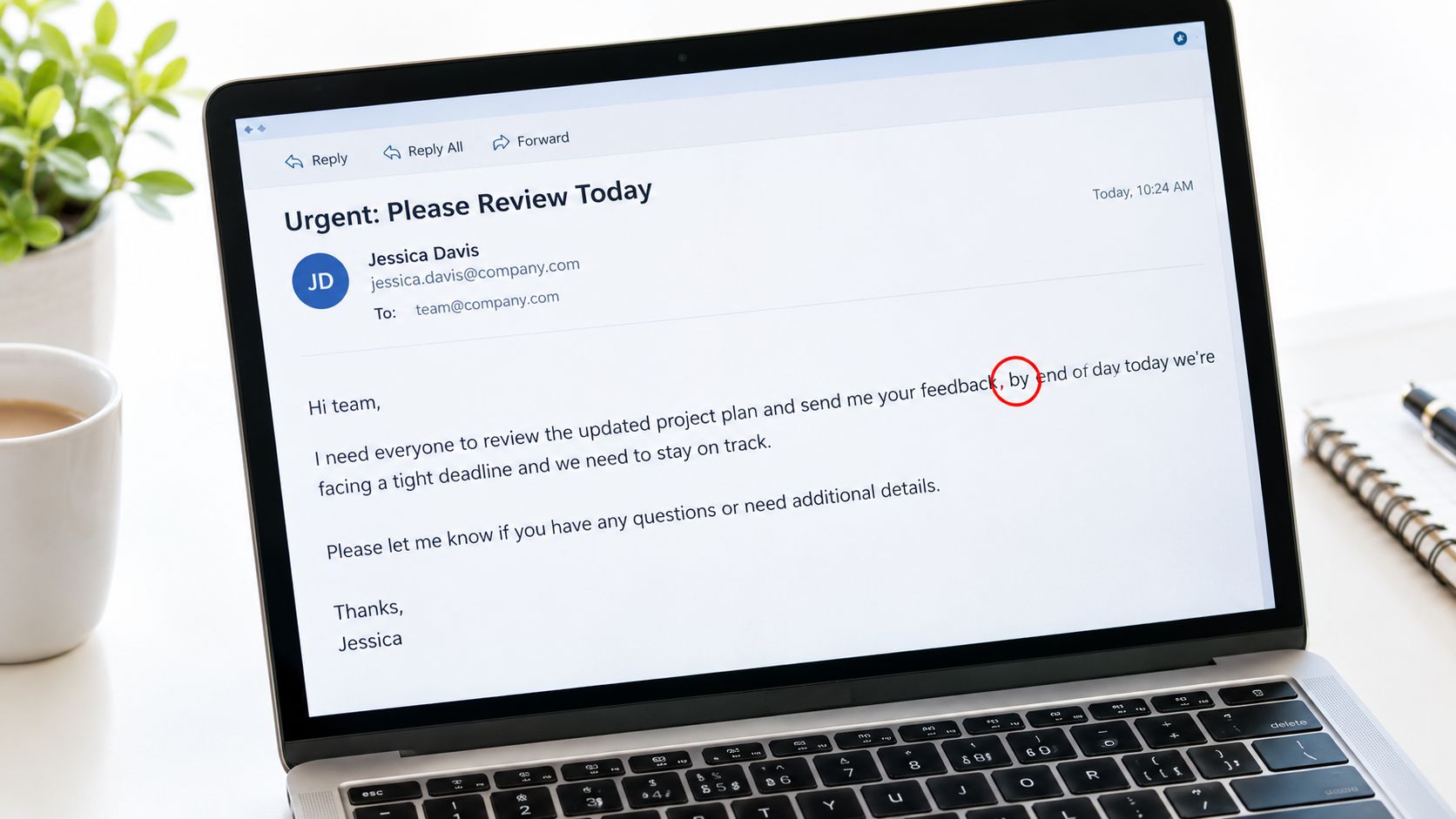
This guide gives you a practical habit: before adding or deleting a comma, ask whether you're joining two complete thoughts and whether the reader benefits from a visible boundary. That habit helps with emails, documentation, user interface copy, and code comments, especially when English isn't your first language.
When a Missing Comma Changes Everything
Consider this sentence in a deployment note:
The patch completed and the monitoring dashboard showed no errors.
At first, it may feel compact and efficient. But two readings are possible. The first clause says the patch completed. The second says the dashboard showed no errors. Because both thoughts can stand alone, the comma before and gives the reader a clearer boundary:
The patch completed, and the monitoring dashboard showed no errors.
The comma doesn't create the relationship. The conjunction and does that. Instead, the comma helps readers recognize where one complete thought ends and the next begins.
Now compare it with a sentence that has only one subject:
The patch completed and showed no errors.
Here, the patch performs both actions. The sentence doesn't join two independent clauses, so a comma would interrupt the shared structure:
The patch completed, and showed no errors.
The patch completed and showed no errors.
The second version is the natural choice.
Read for structure, not just pauses
A pause can help you notice a problem, but it isn't a complete punctuation rule. Different people pause differently, and writers often insert commas wherever their voice slows down. A better first question is:
Can the words on both sides of the conjunction stand alone as sentences?
If the answer is yes, you're probably dealing with a compound sentence. If one side depends on the other, the comma decision follows a different pattern.
This distinction matters because a missing comma can make a long sentence difficult to scan, while an unnecessary comma can split a subject from its verb or separate a shared verb phrase. The reader shouldn't have to reconstruct your syntax from context.
The useful editing habit
When a sentence feels awkward, don't immediately search for a comma. Mark the main subject and verb on each side of the conjunction. Then decide whether you want to present two coordinated thoughts, one subject doing two things, or two subjects sharing one action.
That small diagnostic step turns punctuation from guesswork into editing. You're not memorizing a decoration rule. You're showing the reader how your ideas are organized.
Understanding Independent Clauses and the FANBOYS Rule
An independent clause is a group of words that can stand alone as a complete sentence. It normally contains a subject and a verb and expresses a complete thought.
Try these examples:
- “The build failed.” This can stand alone.
- “The team fixed the configuration.” This can stand alone.
- “Because the build failed.” This doesn't feel complete. It leaves the reader waiting for what happened next.
The first two are independent clauses. The third begins with because and depends on another thought.
For a fuller explanation of the distinction, see this guide to dependent and independent clauses.
The comma plus conjunction pattern
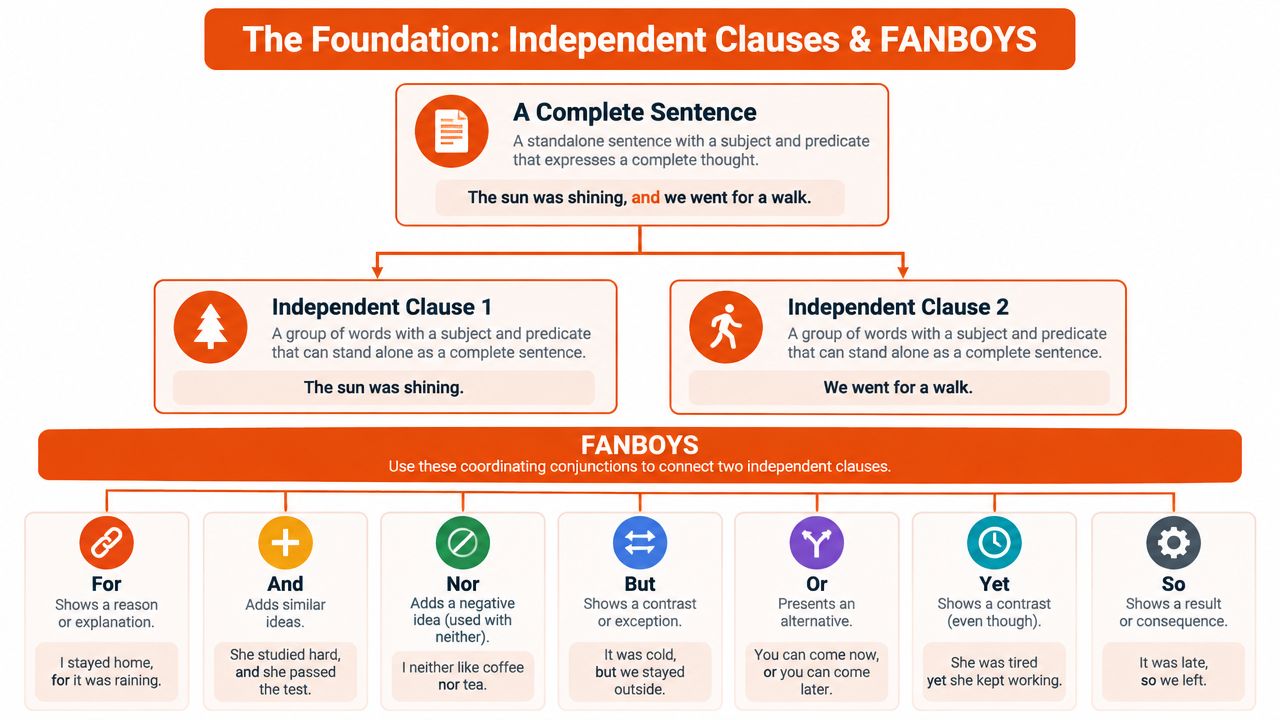
When two independent clauses are joined by a coordinating conjunction, a comma normally comes before the conjunction:
The build failed, but the team fixed the configuration.
Both parts can stand alone:
The build failed.
The team fixed the configuration.
The comma and but work together. The comma marks the boundary, and but tells the reader that the second thought contrasts with the first.
The standard coordinating conjunctions are commonly remembered as FANBOYS:
- For, gives a reason
- And, adds information
- Nor, adds a negative alternative
- But, signals contrast
- Or, presents an alternative
- Yet, signals an unexpected contrast
- So, shows a result
Examples make the pattern clearer:
The API returned an error, so the client retried the request.
The test passed, yet the deployment remained blocked.
The script didn't create the file, nor did it report a useful message.
In each example, the material on both sides can function as a complete thought.
Why the comma matters
A comma alone can't correctly join two independent clauses. That error is called a comma splice:
The API returned an error, the client retried the request.
The reader sees two complete thoughts, but the comma doesn't show how they connect. You need a comma with a coordinating conjunction, a semicolon, or a period. The Purdue OWL guidance on commas presents these as reliable ways to repair the boundary.
Start with structure before style. Once you know that both sides are independent clauses, the normal choice is comma plus FANBOYS. Only then should you consider whether a semicolon or sentence break communicates your intent better.
Compound Sentences Versus Compound Predicates and Subjects
Many comma errors happen because three structures look almost identical on the page. The key difference is whether each side contains its own complete subject and verb combination.
A compound sentence joins two independent clauses:
The server restarted, and the application recovered.
The first clause has the server and restarted. The second has the application and recovered. Each thought can stand alone, so the comma belongs before and.
A compound predicate has one subject with two verbs:
The server restarted and recovered.
Here, the server controls both verbs. You don't need a comma because the sentence contains one independent clause with a combined predicate.
A compound subject has two subjects sharing one verb:
The server and the database restarted.
The subjects share restarted. Again, there's no comma.
| Structure | Example | Comma Needed? |
|---|---|---|
| Compound sentence | The server restarted, and the application recovered. | Yes, normally |
| Compound predicate | The server restarted and recovered. | No |
| Compound subject | The server and the database restarted. | No |
Use the split test carefully
Ask whether you can divide the sentence into two complete sentences without adding a missing subject or changing the meaning.
The server restarted. The application recovered.
That split works, so the original is a compound sentence.
Now try:
The server restarted. Recovered.
The second part isn't a complete sentence in this context. The subject is shared, which points to a compound predicate instead.
Subject repetition is often the fastest clue:
Different subjects usually signal two clauses. A shared subject often signals one clause with a compound predicate.
This isn't a mechanical guarantee. English allows omitted subjects in some constructions, so check the verbs as well. Still, subject repetition gives ESL writers and developers a practical starting point when a sentence contains and, but, or another coordinating conjunction.
Avoid commas that create false boundaries
Writers sometimes add a comma because the second verb feels like a new idea:
The script validates the input, and writes the result.
Unless the second clause has its own subject, the comma makes the shared structure look broken. Write:
The script validates the input and writes the result.
The goal isn't to make every sentence short. It's to show whether the writer has one actor performing multiple actions or two actors expressing separate thoughts.
When the Comma Feels Wrong and Alternatives Help
Some sentences contain two independent clauses, yet the comma feels heavy:
Save the file, and close the editor.
Both save the file and close the editor can function as complete commands, but the sentence may feel like a tightly linked instruction. In short clauses, writers sometimes omit the comma, especially when the meaning remains immediately clear:
Save the file and close the editor.
That doesn't erase the standard rule. It reflects a style choice available in some very short, closely connected clauses. The longer or more complex the clauses become, the more valuable the comma is for helping readers parse the sentence.
Choose punctuation by relationship
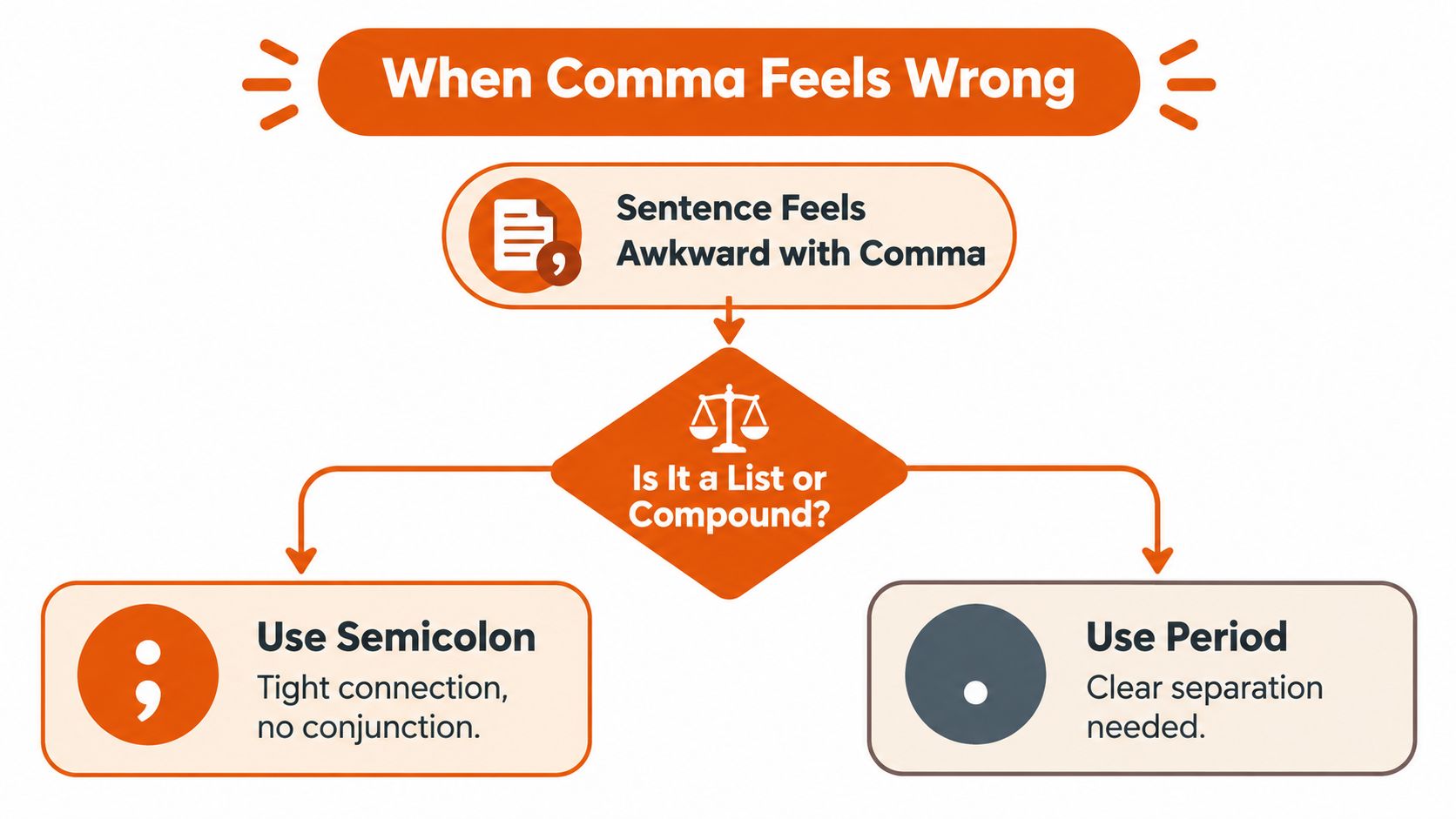
A comma with a coordinating conjunction works well when the conjunction names the relationship:
The request failed, so the client tried again.
A semicolon works when two independent clauses are closely related but no coordinating conjunction is needed:
The request failed; the client tried again.
A period works when the ideas deserve clear separation:
The request failed. The client tried again after checking the configuration.
The choice changes the rhythm and emphasis. A semicolon keeps the thoughts in one sentence without supplying a word like so or but. A period gives each thought more independence.
For examples focused specifically on this alternative, consult compound sentences with semicolons.
A useful decision rule is:
- Keep the comma if removing it could cause a reader to misread the sentence.
- Consider a semicolon when the clauses are tightly connected and you don't want a conjunction.
- Use a period when the connection is weak or the sentence has become difficult to follow.
Test the sentence in its real setting
A sentence in product documentation may need more separation than the same sentence in a button label or brief instruction. Technical writing often benefits from explicit relationships because readers scan for actions, conditions, and results.
Read the sentence as a user would, not as its author. If the reader must pause and backtrack to determine where one thought ends, preserve the comma or split the sentence. If the clauses are brief, parallel, and unmistakably connected, a compressed form may be easier to read.
The best punctuation choice serves intent. Grammar supplies the boundaries, but editing determines how much space the reader needs.
<iframe width="100%" style="aspect-ratio: 16 / 9;" src="https://www.youtube.com/embed/41XNKfR56OY" frameborder="0" allow="autoplay; encrypted-media" allowfullscreen></iframe>Fixing the Three Most Common Comma Mistakes
Think of punctuation errors as sentence bugs. First identify the structure, then apply the smallest repair that makes the relationship clear.
The comma splice
A comma splice joins two independent clauses with only a comma:
The dashboard loaded, the metrics were missing.
Use one of these repairs.
Add a conjunction:
The dashboard loaded, but the metrics were missing.
This version states the contrast directly.
Use a semicolon:
The dashboard loaded; the metrics were missing.
This keeps the close relationship without adding a conjunction.
Use separate sentences:
The dashboard loaded. The metrics were missing.
This gives each fact full emphasis. The Purdue OWL extended comma rules distinguish this boundary from structures such as compound predicates, where the comma isn't needed.
The missing comma before a conjunction
When two independent clauses are joined by and, but, or, nor, for, yet, or so, the comma normally comes before the conjunction:
The worker stopped, and the queue began to grow.
Without the comma, the sentence may still be understandable, but the boundary is less visible. This matters more when either clause is long, contains technical terms, or includes its own internal punctuation.
Don't apply the same fix to a shared subject:
The worker stopped and restarted.
That sentence has one subject and two verbs. Adding a comma would create an unnecessary break.
The unnecessary interruption
A comma can also disrupt the flow when it separates a subject from its verb or breaks a shared predicate:
The updated client for mobile devices, sends diagnostic data.
Remove the comma:
The updated client for mobile devices sends diagnostic data.
A similar problem appears when writers insert a comma before a second verb:
The service checks permissions, and writes an audit entry.
If the service performs both actions, write:
The service checks permissions and writes an audit entry.
Before publishing, run this short debugging pass:
- Mark the subjects and verbs. Look for a complete thought on each side of the conjunction.
- Test the boundary. If both sides stand alone, don't join them with a comma alone.
- Choose the repair. Use comma plus conjunction, a semicolon, or a period.
- Remove false breaks. Check for commas between a subject and verb or inside a shared predicate.
- Read for intent. Make sure the punctuation shows addition, contrast, result, close connection, or separation.
For a broader collection of related sentence problems, the guide to bad grammar examples can provide extra practice.
How to Edit Compound Sentences Confidently
You don't need to memorize every exception to edit compound sentences well. Use a repeatable decision path.
First, find the conjunction or punctuation mark connecting the ideas. Then ask whether the material on each side can stand alone. If both sides are independent clauses, choose between comma plus a coordinating conjunction, a semicolon, or a period based on the relationship and the reader's needs.
Practical rule: Punctuation should reveal the sentence's design, not merely reproduce the pause you hear.
Try these practice items:
- “The upload finished and the report appeared.”
If the upload and report have different subjects, add a comma before and. - “The upload finished and displayed a confirmation.”
Keep the sentence as written if the upload performs both actions. - “The upload finished, the report appeared.”
Repair the comma splice with a conjunction, semicolon, or period.
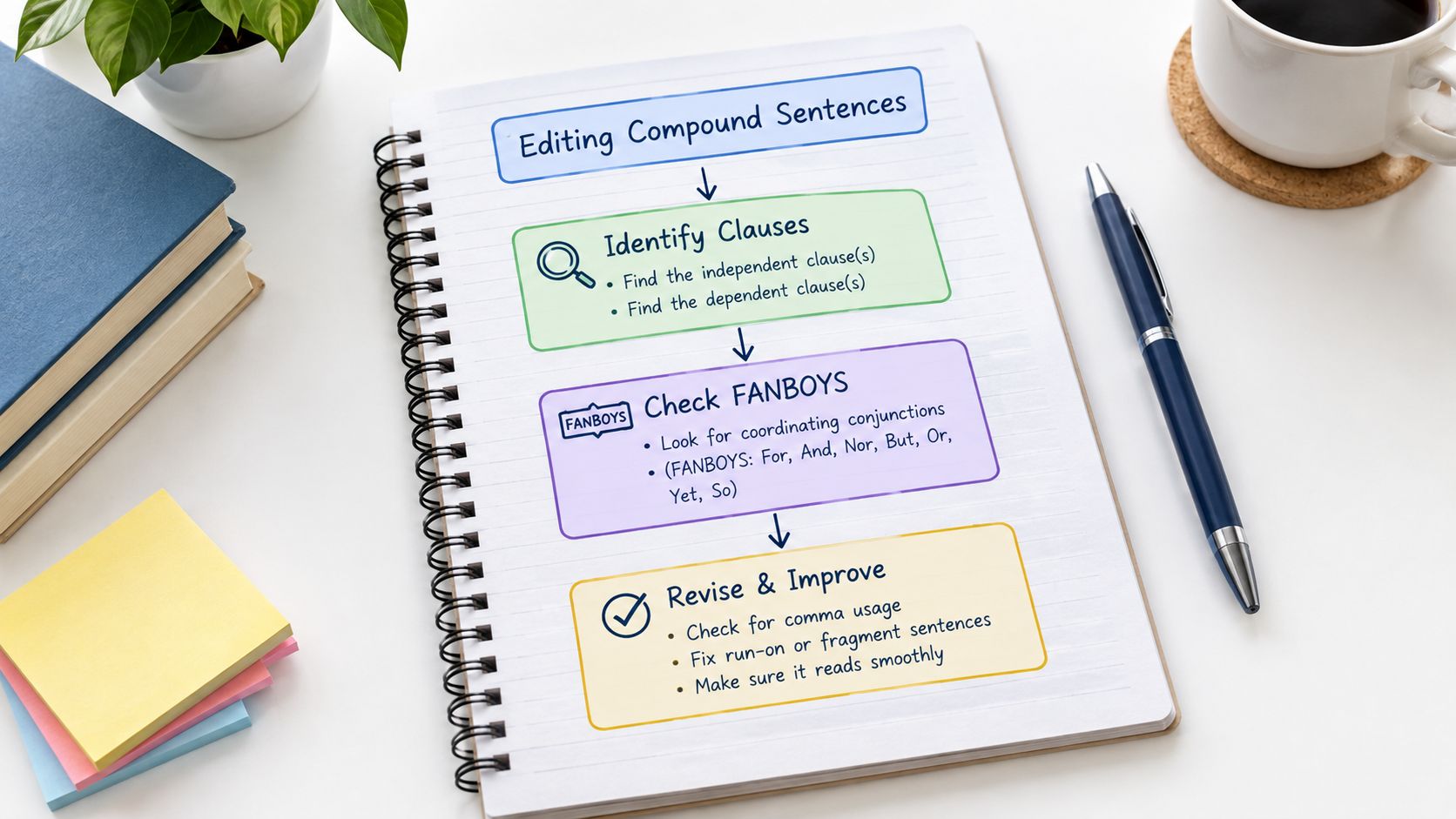
For real-world editing, select the sentence and inspect it in context. A grammar and punctuation tool can flag possible boundaries, but you still need to decide whether the writer intended one shared action or two complete thoughts. RewriteBar, for example, processes selected text to correct grammar, spelling, and punctuation while letting you review the wording in the app where you're writing.
With practice, the question becomes less stressful. You'll recognize the structure, identify the relationship, and choose punctuation that helps the reader move forward without rereading.
If you regularly edit emails, documentation, or code comments, use RewriteBar to check selected text for grammar and punctuation issues while you work. Pair its suggestions with the independent-clause test in this guide, then keep the version that best expresses your intended relationship between ideas.

More to read
Mastering Articles in Grammar for Better Writing
Master articles in grammar with clear rules for definite, indefinite, and zero articles. Learn exceptions, avoid common errors, and practice with AI tools.
Common Spelling Errors and How to Stop Making Them
Learn why common spelling errors happen, the patterns behind them, and practical strategies and tools to catch and prevent mistakes in your writing.
English Spelling Rules Made Simple
Master English spelling rules with this clear, practical guide. Learn core patterns, common exceptions, and quick fixes for non-native speakers.
Tags
Written by
Mathias MichelPublished
September 24, 2026