Mastering Articles in Grammar for Better Writing
Master articles in grammar with clear rules for definite, indefinite, and zero articles. Learn exceptions, avoid common errors, and practice with AI tools.
Written by
 Mathias Michel
You're writing an email, product label, or bug report, and one tiny decision brings the whole sentence to a halt: should it be a, the, or nothing? You might know the vocabulary perfectly, yet still hesitate over “I've attached ___ updated file” or “Users can access ___ settings.”
That hesitation isn't a sign that your English is weak. Articles in grammar package information for the reader. They signal whether a noun is new, specific, familiar, general, or treated as a concept. Once you read them as information markers rather than decorative words, article choices become easier to diagnose.
Why Articles in Grammar Trip Up Even Fluent Writers
A sentence such as “Please review proposal” feels incomplete, but the correction isn't always “Please review the proposal.” The right article depends on what the reader knows. If you've already discussed one proposal, the proposal points to that known document. If you're asking someone to review any proposal from a group, a proposal introduces one non-specific example. If you're discussing proposals as a category, you may need no article at all: “Proposal writing takes practice.”
This gives us a useful mental model. Think of articles as labels attached to nouns:
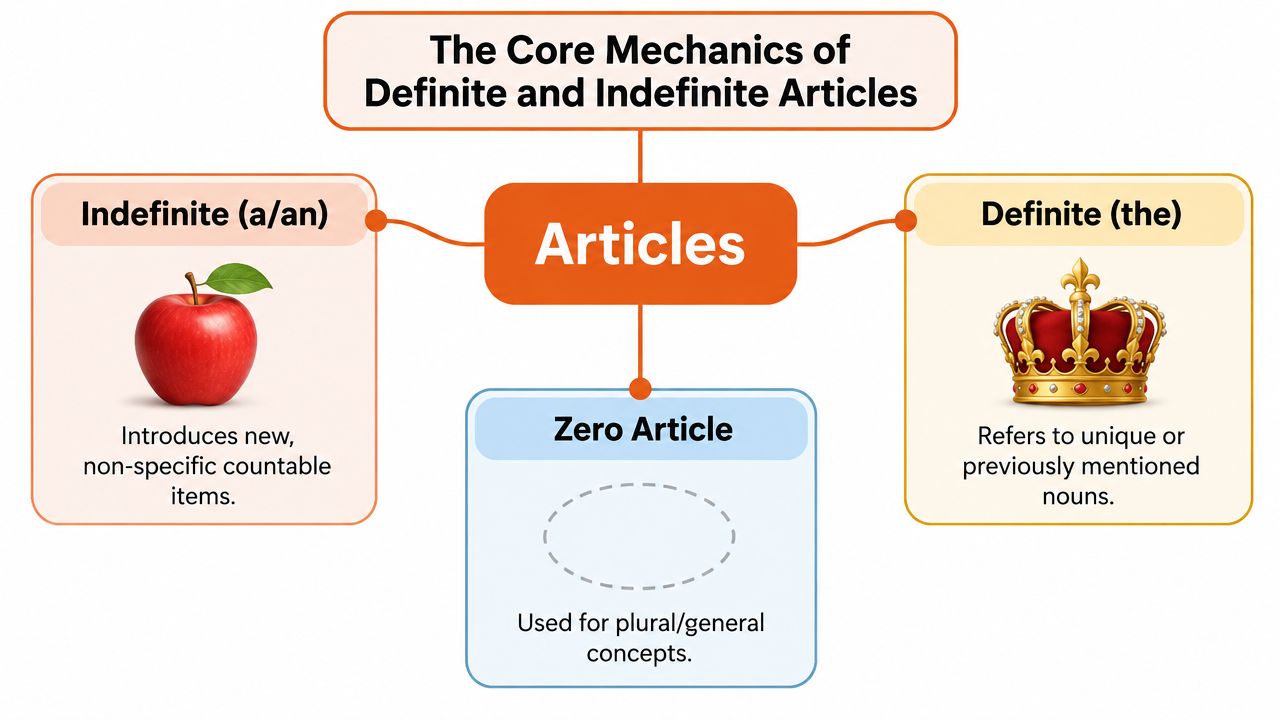
- A or an introduces one countable item without identifying which one.
- The points a spotlight at a particular noun.
- Zero article, meaning no article, often presents a noun as general, abstract, plural, or part of a fixed expression.
The difficulty comes from context. English speakers don't choose articles by looking only at the noun. They consider whether the noun can be counted, whether it has appeared before, whether the listener can identify it, and whether the sentence belongs to a compressed style such as a headline or button label.
Practical rule: Before choosing an article, ask what you want the reader to identify, introduce, or understand generally.
A fluent writer can still make an error when revising quickly because an edit changes the information status of a noun. “We need a solution” may become “We need the solution” after the team has agreed on one specific approach. The grammar changes because the meaning changes.
The most reliable path to confidence is therefore not memorizing isolated rules. It's learning to notice how English moves from new information to shared information, and from individual objects to general ideas.
The Core Mechanics of Definite and Indefinite Articles
Start with the indefinite articles, a and an. They work with a singular countable noun when you're introducing one item without identifying a particular item. Imagine reaching into a container of identical objects and pulling one out. You know it's one object, but neither you nor the reader needs to know which one.
- “We need a designer for the landing page.”
- “She reported an error in the checkout flow.”
- “I'm looking for a solution.”
The choice between a and an depends on sound, not spelling. Use an before a vowel sound, as in “an update” or “an hour.” Use a before a consonant sound, as in “a user” and “a European project.” The initial sound in “user” is /y/, while the initial sound in “hour” is a vowel.
The works differently. It acts like a spotlight, directing the reader toward a noun they can identify. That identification may come from an earlier sentence, the immediate situation, or shared knowledge.
- “I received a message. The message was difficult to understand.”
- “Please open the dashboard.”
- “The moon appears in the night sky.”
In the first example, a message introduces an unspecified message. The second mention becomes the message because both writer and reader can identify it. In the dashboard example, the surrounding task may make the intended dashboard clear.
Countable and uncountable nouns
Article decisions also depend on noun type. A singular countable noun can usually take a, an, the, or another determiner:
- “a report”
- “an issue”
- “the report”
- “this issue”
Uncountable nouns name substances, materials, fields, or ideas that English generally treats as mass rather than separate units. Information, water, advice, and research commonly behave this way in their general forms. You can say “I need some information” or “I need the information,” but not usually “I need an information.”
To refer to one unit, add a countable expression:
- “a piece of information”
- “a glass of water”
- “a piece of advice”
- “a research project”
The meaning can shift sharply when you change the article:
| Sentence | Meaning |
|---|---|
| “We need a plan.” | One plan, not yet specified |
| “We need the plan.” | A particular plan is already identifiable |
| “We need plans.” | Plans in general or multiple plans |
| “Planning takes time.” | The activity as a general concept |
For more examples, see this guide to the basic rules of grammar. Then test each sentence by asking three questions: Is the noun singular and countable? Is it identifiable? Am I discussing one example or a general idea? Those questions usually reveal whether you need a, an, the, or no article.
<iframe width="100%" style="aspect-ratio: 16 / 9;" src="https://www.youtube.com/embed/cvwhip4dw3Y" frameborder="0" allow="autoplay; encrypted-media" allowfullscreen></iframe>Embracing the Zero Article in English Writing
Many learners receive a simple instruction: put an article before every noun. That advice helps with some singular countable nouns, but it creates a new problem when writers begin adding the to words that should remain general. English has a deliberate zero article system, and omission often carries meaning rather than signalling an error.
Use no article when a plural noun refers to a class or category:
- “Users expect clear instructions.”
- “Reports can contain outdated information.”
- “Dogs need regular exercise.”
These sentences don't identify particular users, reports, or dogs. They make broad statements. Adding the changes the scope: “The users expect clear instructions” refers to a known group, perhaps the users of one application.
The same distinction appears with uncountable nouns used generally:
- “Information travels quickly.”
- “Research requires patience.”
- “Water is essential.”
With the, the meaning becomes specific:
- “The information in this report is outdated.”
- “The research for this project took months.”
- “The water in this bottle is warm.”
Where omission sounds natural
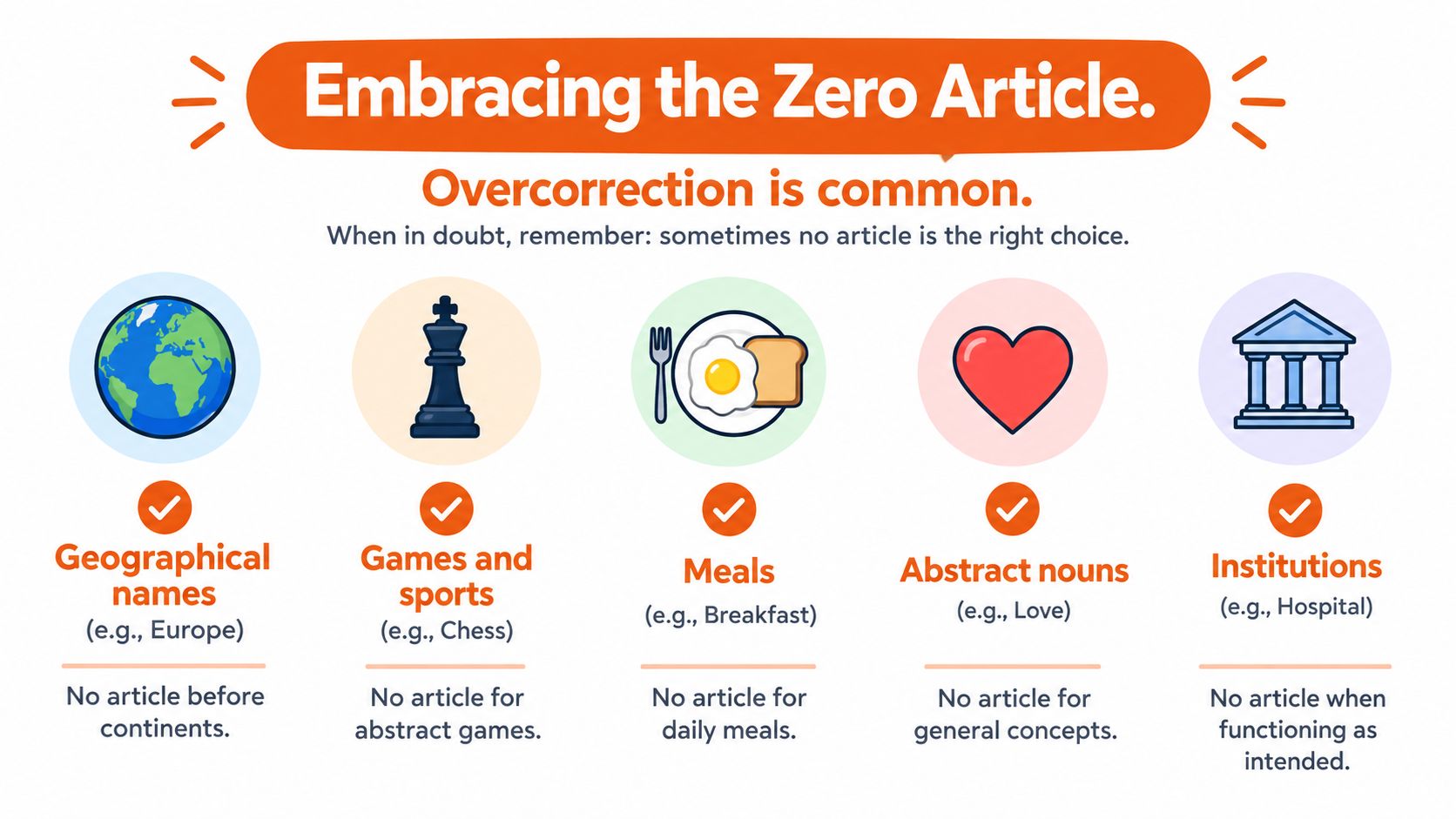
Proper names often appear without an article: “Europe,” “France,” “Maria,” and “RewriteBar.” Some geographical names do take the, especially names containing a descriptive plural or a common noun, such as “the Netherlands” or “the United States.” The choice belongs to the name itself, so learn it as part of the expression rather than applying one universal rule.
Fixed phrases create another important pattern:
- “go to bed”
- “be at work”
- “go to school”
- “be in prison”
- “have breakfast”
- “play chess”
These phrases focus on the purpose or activity associated with the institution, meal, or game. “She went to the hospital” can refer to the building or a visit, while “She went to hospital” in some varieties of English can emphasise receiving medical treatment. Regional usage matters, so writers should follow the English variety and audience they've chosen.
A quick omission test
Before inserting the, ask:
- Is the noun plural and general?
- Is it an uncountable idea or substance used generally?
- Is it a proper name?
- Is it part of a familiar institutional, meal, or activity phrase?
- Would the make the sentence sound narrower than intended?
Academic writing, instructions, and headlines often use compact noun phrases, which makes this test especially useful. “Data analysis requires care” presents a field or activity. “The data analysis requires care” points to one identifiable analysis.
Zero article isn't an empty choice. It tells the reader to interpret the noun broadly, conceptually, or functionally.
Navigating Articles in Headlines and UX Copy
A full sentence and a compressed interface label serve different purposes. In a paragraph, “The user has created a new account” follows ordinary article patterns. In a dashboard, Create account is clearer and faster than Create an account, even though the longer version would be natural in a complete sentence.
This style is sometimes called block language in interfaces and headlinese in news writing. Space, scanning speed, and predictable conventions encourage writers to remove articles when the meaning remains obvious.
Compare these pairs:
| Full sentence | Compressed version |
|---|---|
| “The system detected an error.” | “Error detected” |
| “A new report is available.” | “New report available” |
| “Open the settings menu.” | “Open settings” |
| “The team launches a new feature.” | “Team launches new feature” |
The omission works because readers understand the format. A status label such as Payment failed doesn't need to identify one payment through the. It reports an event. A button such as Add card describes an action, not a complete sentence addressed to a particular card.
When omission helps
Remove an article when the text is a short label, action, status, or headline and the noun's role is immediately clear:
- Download report
- View details
- Account settings
- Password reset required
- New feature released
Keep the article when removing it causes ambiguity, changes the intended meaning, or makes the wording sound careless rather than compact. “Contact support” works as a button because support names a service. “Contact customer” is unclear because the reader may ask, “Which customer?”
Headlines also omit articles for rhythm:
- “Company opens new office”
- “Researchers discover rare plant”
- “Government announces policy”
That style shouldn't automatically migrate into formal prose. A report may require “The company opened a new office,” while a headline benefits from the shorter structure.
For broader principles on making compressed text easier to scan, consult this guide to clarity in writing. The central question is practical: Does the reader need the article to identify the noun, or does the format already provide enough context?
Email subject lines
Subject lines sit between ordinary grammar and headline style. Updated contract for review is concise and professional. The updated contract for your review is more complete and may sound appropriate when the recipient knows exactly which contract you mean.
Use the version that matches the relationship:
- Action needed: invoice approval for a compact internal subject line
- Action needed on the invoice when one specific invoice has already been discussed
- A question about your proposal when introducing a topic without assuming prior identification
Compression should remove predictable words, not meaningful signals. If an article carries the distinction between one item and a known item, keep it.
The Surprising History of English Articles
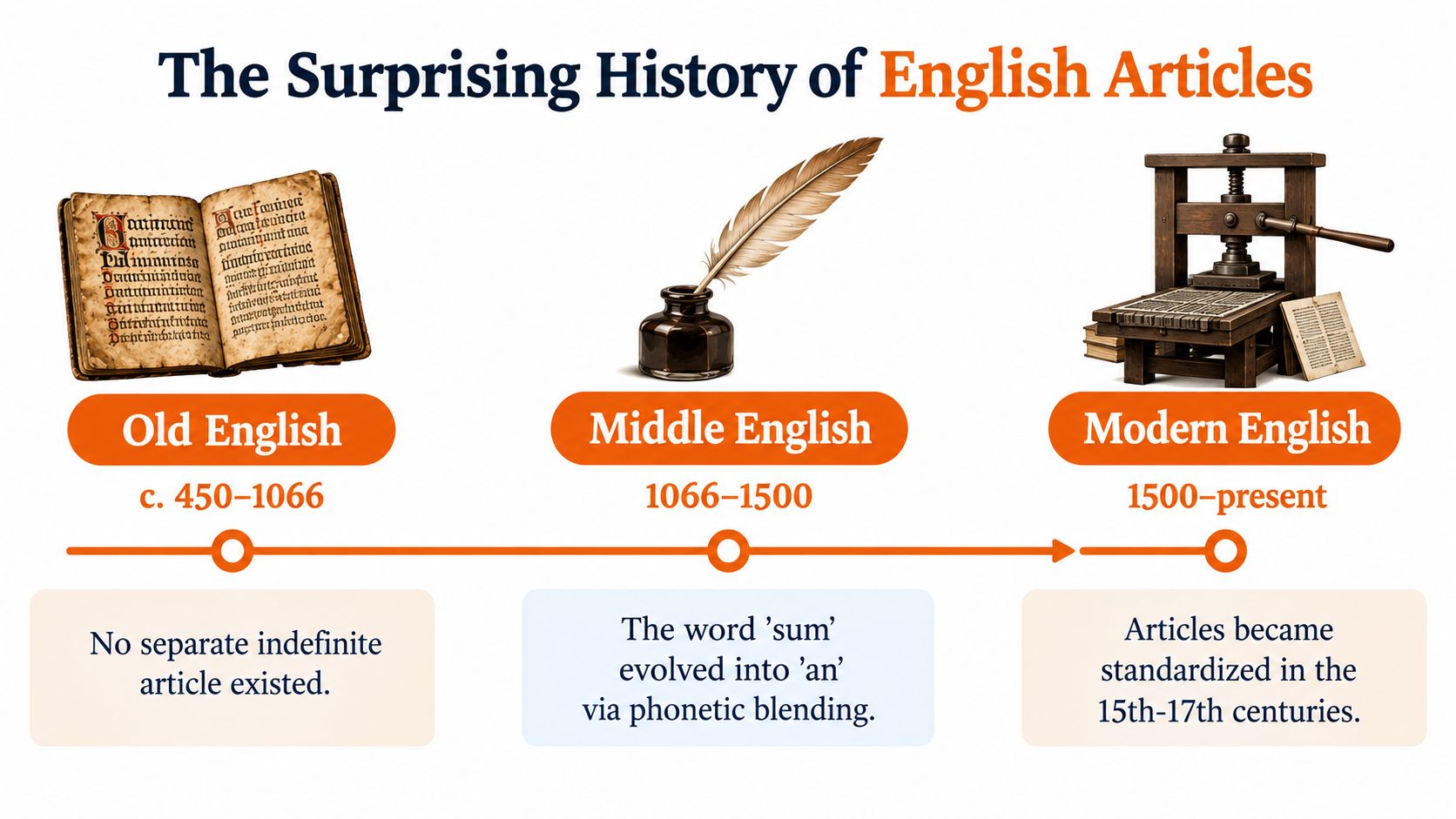
English articles may seem like fixed parts of every noun phrase, yet their roles emerged through historical change. Old English had no separate indefinite article. Its definite article developed from the demonstrative sē, a form connected with pointing to or identifying something. The indefinite article later grew from the numeral ān, meaning “one.”
The shift from numeral to indefinite article is placed in the late eleventh or early twelfth century, during the movement from Old English to Middle English, according to this historical overview of English article usage. This process is called grammaticalization: an ordinary word gradually acquires a grammatical job. A word that once counted one object can, over time, signal that a noun refers to one non-specific member of a group.
A wider linguistic perspective
English is one possible solution to noun reference, not the world's default. In the WALS survey of 620 languages, 216 used a definite word distinct from a demonstrative, 69 used a demonstrative as the definiteness marker, 92 used a definite affix on the noun, 45 had no definite article but still had an indefinite article, and 198 had neither type of article, according to the World Atlas of Language Structures overview.
A separate APiCS study of 473 languages found an indefinite article in 204 of them. Among those languages, 91 used a form distinct from the numeral “one,” while 90 used a form identical to “one,” as reported in the APiCS Online chapter on indefinite articles. These findings place English in a broader pattern while showing that article systems are far from universal.
Why the history helps learners
The history gives learners a more useful frame. Article decisions are not pieces of a universal logic system waiting to be recovered. They are small markers that English inherited, reshaped, and attached to particular patterns of reference.
By Early Modern English, around Shakespeare's era, article use was much closer to current patterns. Grammar writers in the 1700s and 1800s then formalized definite and indefinite articles through school grammar traditions.
That sequence explains why articles feel partly logical and partly idiomatic. In a full sentence, an article can signal whether a reader should identify a known noun or meet a new one. In compressed UX copy, email text, or a headline, surrounding context may carry part of that work. Treat articles like tools shaped by use: first ask what the noun means here, then check whether the phrase follows a fixed convention.
Practicing Grammar Workflows with RewriteBar
Rules become durable when you practise them on sentences you write. An email, specification, support reply, or blog draft contains better training material than a disconnected worksheet because every article choice has a communicative purpose.
A focused editing workflow can turn those choices into quick lessons:
Start with your original sentence
Write without interrupting your flow. If you hesitate, choose the version that best matches your intended meaning and mark the sentence for review. Don't rewrite the whole paragraph immediately, because surrounding context often determines whether a noun is new or identifiable.
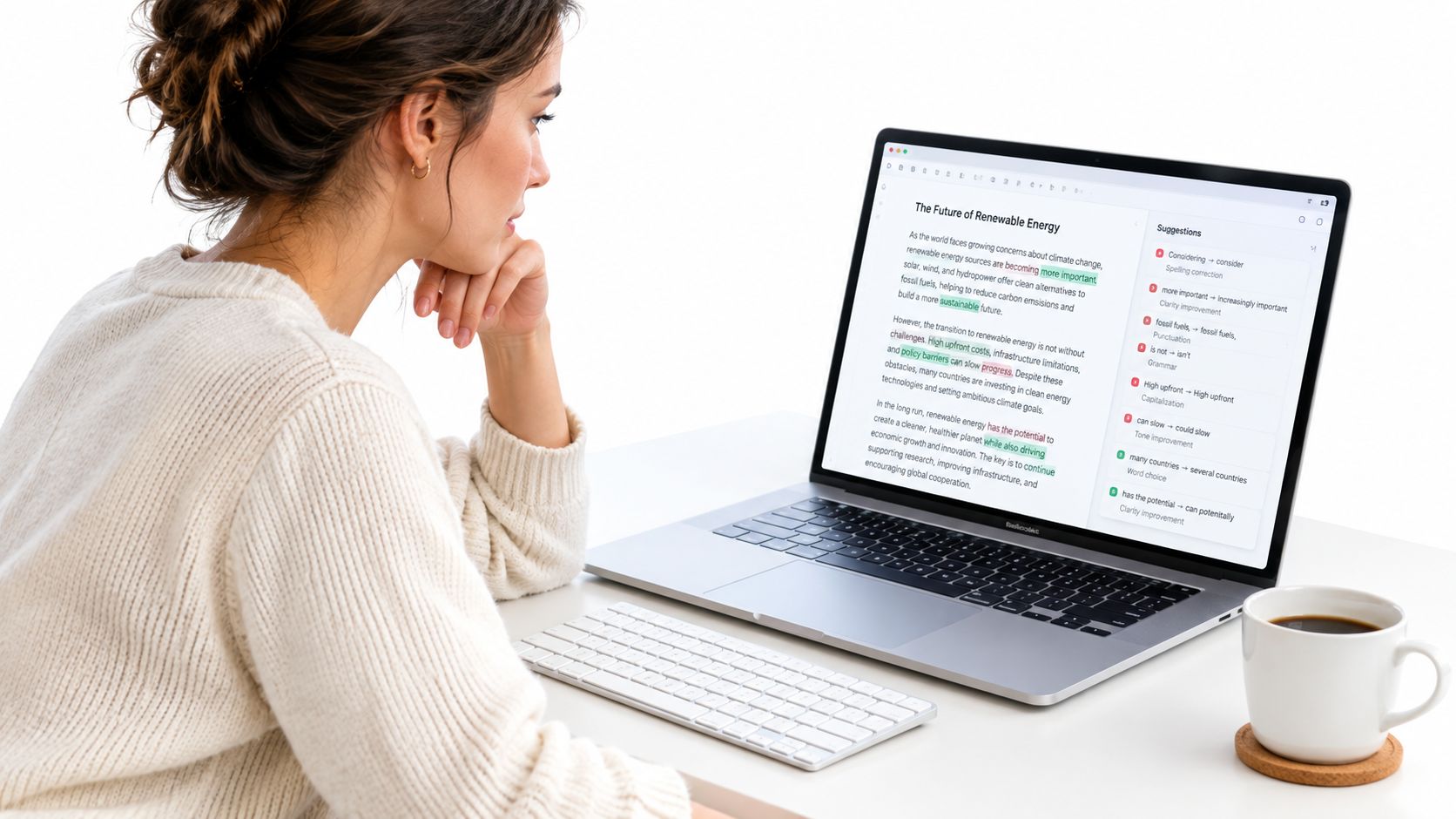
Select the sentence or paragraph, then run a grammar review in your writing assistant. RewriteBar is a macOS AI writing assistant that works in apps with text input, can analyse selected text for grammar and clarity, and lets you compare the original with the suggested revision.
Use a targeted prompt
A general “fix grammar” command may correct the sentence without teaching you why. A custom prompt can force the review to focus on article logic and preserve your voice.
Try this prompt:
Review article usage only. For every change involving a, an, the, or zero article, explain whether the noun is new, identifiable, general, plural, uncountable, or part of a fixed expression. Preserve my meaning and tone.
For short-form content, use a separate instruction:
Review this UI copy for article usage. Recommend standard grammar for labels, then provide a compact version suitable for a button, status message, or menu item. Explain any article omission that changes the register.
For multilingual work, add:
Compare the article choices with the meaning in the original text. Don't add an article merely because the source language uses a determiner. Flag cases where English requires a countable unit such as “a piece of information.”
Compare, then accept selectively
Read the original and revision side by side. Ask whether the suggested article changes the reader's interpretation:
- Does a introduce one non-specific item?
- Does the identify a known item?
- Does zero article preserve a general meaning?
- Has the sentence moved from prose into a label or headline style?
Keep a personal correction log with three columns: original phrase, revision, and reason. Patterns appear quickly. You may discover that you overuse the before abstract nouns, omit an before vowel sounds, or add articles to plural generalisations.
The assistant should support your judgement, not replace it. Context remains the final test, especially when a sentence can be grammatical in more than one form but the intended scope differs.
Common Article Mistakes and How to Fix Them
Advanced writers usually don't struggle with the simplest examples. They struggle when a noun changes role during editing. A phrase that was general in a draft can become specific after a previous sentence identifies it, and a full sentence can become a headline when it moves into a title field.
| Common mistake | More natural choice | Why |
|---|---|---|
| “We need an information.” | “We need some information.” | Information is generally uncountable |
| “The users need clear navigation.” | “Users need clear navigation.” | The plural is general |
| “Please review a attached file.” | “Please review the attached file.” | The file is identifiable, and “attached” begins with a consonant sound |
| “She studies the biology.” | “She studies biology.” | The field is general |
| “I found a issue.” | “I found an issue.” | Issue begins with a vowel sound |
Don't assume every abstract noun needs zero article, either. “Love matters” is general, but “The love between the siblings was obvious” refers to a specific relationship. Articles respond to meaning, not to whether a noun feels abstract.
Proper names create another trap. Writers may add the before a company name, person's name, or continent because the noun feels important. Usually, “I contacted Microsoft,” “Maria approved the draft,” and “Europe has many language traditions” are the natural forms. Names with built-in descriptive structures follow their own conventions, so check the established form rather than guessing.
For a broader review of grammar habits, use this resource on how to improve English grammar. Before sending or publishing, run this final check:
- Identify the noun: Is it singular, plural, countable, uncountable, or a proper name?
- Check the reader's knowledge: Is the noun new, previously mentioned, or obvious from the situation?
- Test the scope: Does the sentence describe one item, a known item, or a general class?
- Check the register: Is this normal prose, a headline, a subject line, or interface copy?
- Read aloud: Does the article match the sound that follows it?
- Review omission: Would adding the make a general idea unnecessarily specific?
Article questions often appear alongside punctuation questions because both depend on sentence structure and intended meaning. If you're also unsure about punctuation around explanations, this guide to when to use a comma before because offers a useful companion reference.
RewriteBar can review selected text for grammar, spelling, punctuation, tone, and clarity while preserving your writing flow across macOS apps. Try an article-focused prompt on your next email or UX draft, then visit RewriteBar to explore custom workflows for practising and refining your English.

More to read
Commas in Compound Sentences: A Clear Guide for 2026
Master commas in compound sentences with this clear guide. Learn the rules, avoid common mistakes, and improve your writing today.
Common Spelling Errors and How to Stop Making Them
Learn why common spelling errors happen, the patterns behind them, and practical strategies and tools to catch and prevent mistakes in your writing.
English Spelling Rules Made Simple
Master English spelling rules with this clear, practical guide. Learn core patterns, common exceptions, and quick fixes for non-native speakers.
Tags
Written by
Mathias MichelPublished
September 25, 2026