750 Word Essay That Scores Well
Learn how to plan, draft, and edit a 750 word essay with the right paragraph split, timing, and word-economy tips. Includes a sample essay and revision
Written by
 Mathias Michel
You're staring at a blank document with a 750-word minimum and two competing worries. If you write freely, you'll lose focus. If you plan too tightly, you'll produce a thin response that sounds like notes rather than an essay. The useful shift is to stop treating the assignment as a page-filling exercise. A 750 word essay is a limited word budget, and every paragraph needs to earn its space through a claim, evidence, explanation, or purposeful conclusion.
The format is manageable once you decide where your words will go before you draft. A 2026 academic writing guide places standard essays commonly between 500 and 1,500 words, with high school essays often between 500 and 800, so 750 words sits comfortably inside a familiar short-form range (academic writing guidance on essay length). The following method gives you a paragraph budget, a timed workflow, a worked sample, practical cuts, and a final checklist. With those decisions made in advance, you can produce a focused draft in roughly two hours instead of negotiating with every sentence.
Why 750 Words Feels Harder Than It Looks
A 750-word assignment looks generous until you try to make an argument inside it. You have enough room to develop an idea, but not enough room for a long historical background, several unrelated examples, and a conclusion that introduces a new argument. Students often lose marks because they spend their first paragraph explaining the topic instead of answering the prompt.
The first pressure is the lack of a warm-up period. In a longer paper, a little context can help orient the reader. In a short essay, context has to serve the thesis immediately. A sentence such as “Social media has become very popular in modern society” consumes space without creating a position your reader can evaluate.
The second pressure is that redundancy becomes visible. Repeating the same point with slightly different wording may feel like development while drafting, but the reader sees one idea taking up several sentences. The third pressure is transition cost. A short essay still needs logical movement, yet every transition should clarify the relationship between ideas rather than decorate the paragraph.
Practical rule: If a sentence doesn't make the claim clearer, support it, explain it, or connect it to the prompt, question whether it deserves space.
Treat the assignment as five linked decisions:
- Paragraph split: Decide how many words each part can spend.
- Timing workflow: Give planning, drafting, and revision separate jobs.
- Worked sample: Study how a complete argument uses its limited room.
- Word economy: Replace inflated phrases with direct language.
- Revision checklist: Check argument and clarity before correcting surface errors.
The word count isn't asking you to say everything you know. It's asking you to select the most relevant ideas and develop them sufficiently. Once you budget rather than guess, a 750 word essay becomes a compact argument with boundaries you can work inside.
The Paragraph Budget That Makes the Essay Work
A 750-word essay works like a small budget. Every paragraph receives a limited amount of space, so each one needs a clear job. A useful starting point is the 10/80/10 structure: about 75 words for the introduction, 600 for the body, and 75 for the conclusion (standard essay proportions and paragraph guidance). Divide the body into three paragraphs of roughly 200 words, or use four shorter paragraphs when the prompt requires more separate points.
A strong body paragraph usually needs room for a claim, concrete evidence or an example, and analysis. At 150 to 200 words, it can develop one idea without becoming a miniature essay. If it contains only a claim and an example, the reasoning may feel unfinished. If it collects several similar examples, it spends the budget without adding a new layer of meaning.
| Paragraph | Word Budget | Job to Do |
|---|---|---|
| Introduction | About 75 words | Establish the issue, narrow the focus, and state an arguable thesis |
| Body paragraph one | 150–200 words | Develop the first major claim with evidence and analysis |
| Body paragraph two | 150–200 words | Develop the second claim or deepen the central argument |
| Body paragraph three | 150–200 words | Develop the final claim, implication, or counterargument |
| Conclusion | About 75 words | Answer the “so what?” question and return to the thesis with added meaning |
Choose the structure from the prompt, not from habit. A three-point structure fits questions about several reasons, effects, or features. Each body paragraph then handles one independent supporting point. A thesis-driven structure fits questions asking whether, why, or to what extent something is true. Its paragraphs examine one position from different angles, so the essay develops an argument instead of presenting three unrelated answers.
Use the body plan as a spending limit, not a rigid formula. If one claim needs more explanation, reduce repetition elsewhere. A focused body paragraph example can show how evidence and analysis share the same space. Draft those body claims first. Then write an introduction that promises exactly what the essay delivers, rather than using its limited words to make a broad opening.
A Timing-Based Workflow You Can Use Tonight
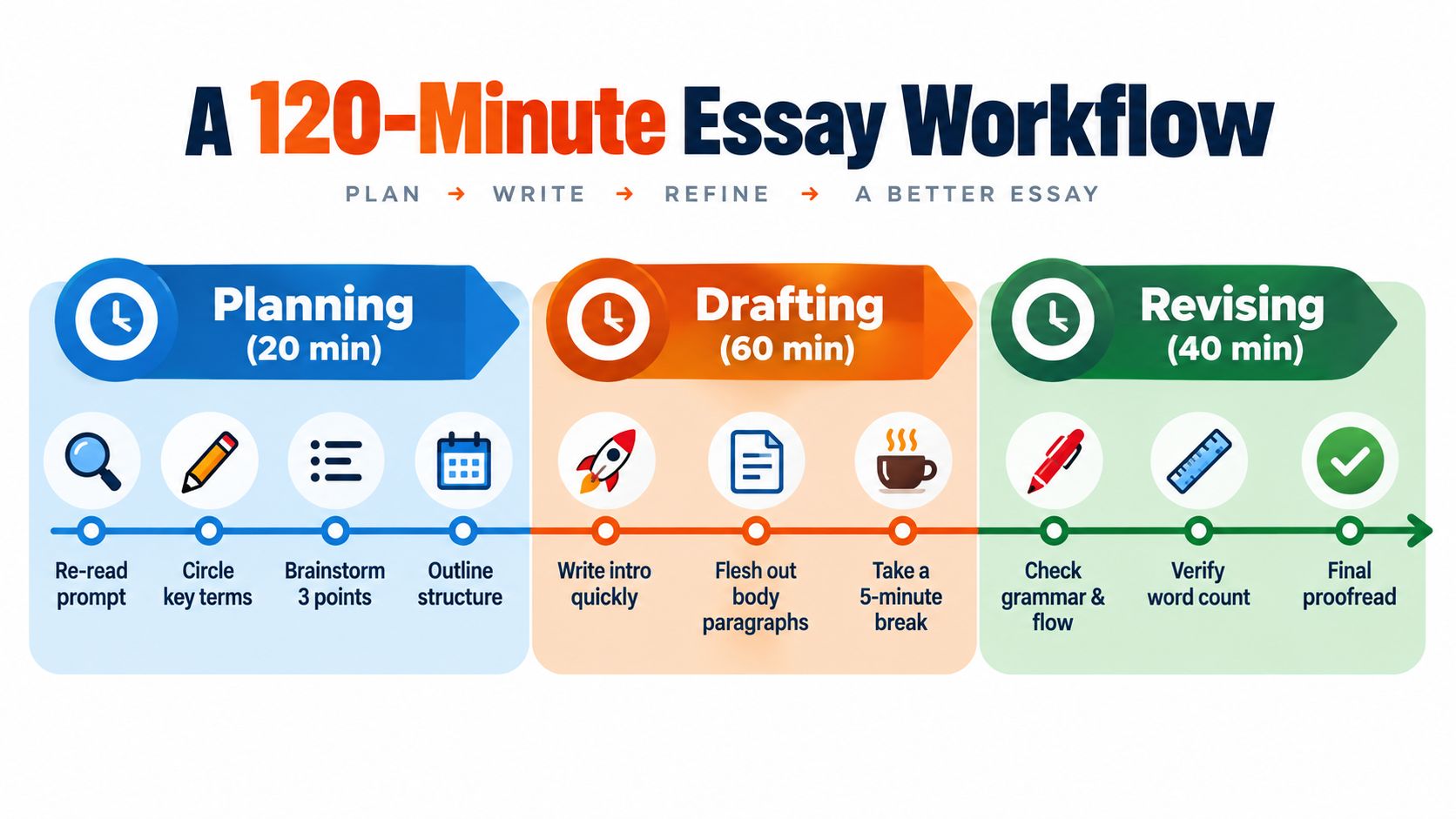
A practical workflow divides the session into 20 minutes of planning, 60 minutes of drafting, and 40 minutes of revision, a schedule also recommended in guidance for writing a 750-word essay (750-word essay workflow). Set a timer before you begin. The point isn't to create pressure for its own sake. It's to prevent planning from expanding until there's no time left to write.
During the first 20 minutes, complete four small tasks:
- Re-read the prompt. Identify the subject, the task, and the limits.
- Circle the command verbs. Words such as analyse, compare, evaluate, or argue require different responses.
- Write a working thesis. Make it one sentence, even if you expect to revise it.
- Sketch three body claims. Put one claim, one possible example, and one explanation under each paragraph.
At the 30-minute checkpoint, you should have a thesis and outline. At 60 minutes, your draft should contain the body paragraphs, even if the introduction is rough or missing. At 90 minutes, you should be revising rather than still generating your first ideas.
Draft in an order that protects the argument
Try writing body paragraph three first, then paragraphs one and two, and the introduction last. This reverse-order method gives you a clearer sense of what you argue before you write the thesis that frames it. If you begin with an ambitious introduction, you may spend the rest of the essay trying to prove a claim that your evidence can't support.
Use the 60-minute drafting block to get complete thoughts onto the page. Don't stop to perfect every transition. If you need a model for working within a shorter assignment, this guide to a 400-word essay offers a useful contrast in scale.
The final 40 minutes need two passes. First, check structure: does every paragraph answer the prompt, and does the evidence support the thesis? Second, cut wordiness and repair sentence-level problems. A timer makes this process concrete. When the drafting block ends, stop adding new points unless the prompt is unanswered.
A Real 750 Word Essay With the Math Shown
Consider this prompt: Argue whether social media does more harm than good for teenagers. The sample below uses a thesis-driven structure. The exact paragraph counts are planning annotations, so the important lesson is how each part earns its space.
Introduction, 78 words
Social media helps teenagers maintain friendships, discover information, and participate in communities beyond school. Those benefits, however, don't settle whether its overall effect is positive. The design of social platforms also encourages constant comparison, rapid reactions, and public approval seeking. For teenagers still developing confidence and judgment, those pressures can affect how they understand themselves and other people. Social media does more harm than good when it turns connection into performance, although careful boundaries can preserve some of its genuine social benefits.
Body paragraph one, 162 words
The strongest harm comes from comparison. Teenagers encounter carefully selected photographs, achievements, and opinions, then measure ordinary moments against those public displays. A person may understand intellectually that a post is incomplete while still feeling that everyone else is happier, more attractive, or more successful. The platform does not need to state that comparison directly. Its steady stream of polished images creates the conditions for it. Identity develops partly through feedback from other people, and social media makes that feedback visible and continuous. Likes and comments can make approval feel measurable, while a quiet post may seem like personal rejection. A teenager who begins posting mainly to receive reassurance may gradually replace self-expression with self-presentation. Social media therefore harms well-being not because teenagers see attractive images, but because the platform links visibility with value. The pressure becomes stronger when comparison follows users throughout the day rather than remaining limited to a particular social setting.
Body paragraph two, 168 words
Social media can also weaken the quality of attention that relationships require. Messaging allows teenagers to remain in contact when they are separated, and group conversations can help an isolated student find companionship. Yet frequent alerts divide attention between the person in front of them and the possibility of a more interesting interaction elsewhere. A conversation becomes harder to follow when participants are also checking reactions, watching short videos, or answering another message. The problem isn't that every brief interruption destroys a friendship. It is that repeated partial attention can make relationships feel available without making them deep. Teenagers may know what their friends posted while knowing less about what those friends fear, hope for, or need. Online contact has value, but contact isn't identical to understanding. When social media rewards speed and constant response, it can train users to treat silence as a problem and reflection as wasted time. That habit can leave teenagers connected to many people while giving fewer relationships the patient attention they need.
Body paragraph three, 171 words
Still, judging social media only by its risks would be unfair. Teenagers use online spaces to find communities that may not exist locally, especially when their interests or experiences make them feel isolated at school. They can exchange creative work, learn from people with different backgrounds, and receive support during difficult moments. These benefits show why a simple ban would miss the issue. The harm depends partly on how platforms are used and how much authority they have over a teenager's routine. A young person who treats social media as one tool for communication can gain connection without allowing public reactions to define personal worth. Schools and families can support that balance by teaching students to question edited images, distinguish popularity from credibility, and set boundaries around attention. Even so, the need for such boundaries reinforces the argument that social media currently creates more risk than benefit for many teenagers. A useful tool shouldn't require users to resist its central pressures without guidance.
Conclusion, 79 words
Social media offers teenagers real connection, but its benefits don't erase the effects of comparison, divided attention, and approval seeking. The central concern is not that young people communicate online. It is that platforms can make visibility feel like value and constant response feel like friendship. Teenagers can use social media more safely when adults teach critical judgment and when users set limits around attention. Until those protections become ordinary, social media does more harm than good because its design amplifies pressures that developing users are still learning to manage.
What the sample is doing
The thesis appears at the end of the introduction because that position gives the reader a clear direction before the evidence begins. The body paragraphs stay within a controlled range, and each one has a claim, an explanation, and a qualification rather than a pile of loosely related examples.
The writer also cuts a possible fifth point. Privacy, misinformation, and sleep could each become relevant, but adding them would force every existing point to become thinner. In a 750 word essay, a smaller number of developed ideas usually serves the argument better than a long list. Reverse-engineer the sample by replacing its three claims with the three claims your own prompt requires.
Word-Economy Moves That Tighten Any Draft
Word economy isn't about making every sentence short. It's about removing language that delays the idea. In a short paper, the largest savings often come from the introduction and from repeated transitions, not from cutting the evidence your argument needs.
Delete dead weight
Watch for empty intensifiers and throat-clearing phrases. They sound formal but rarely add meaning.
-
Before: “It is very important to note that social media really affects teenagers.”
-
After: “Social media affects teenagers.”
-
Before: “In order to understand the issue, readers need to consider comparison.”
-
After: “To understand the issue, readers need to consider comparison.”
The second version states the point without announcing that a point is coming. You can find more principles for direct sentences in this guide to conciseness in writing.
Swap wordy phrases for sharp ones
Make common substitutions while revising:
- “Due to the fact that” becomes “because.”
- “A large number of students” becomes “many students.”
- “At this point in time” becomes “now.”
- “Has the ability to” becomes “can.”
- “In the event that” becomes “if.”
These changes don't make academic writing casual. They make the relationship between subject and action easier to see.
Combine repeated work
If two sentences perform the same job, combine them or delete one. For example:
- Before: “Social media creates pressure. This pressure can affect how teenagers view themselves.”
- After: “Social media creates pressure that can affect how teenagers view themselves.”
A paragraph that runs beyond 200 words should justify the extra space with a new idea, not additional versions of its existing point. Read each paragraph once for meaning, then once with the word count visible. Cut repetition before cutting explanation.
Common Mistakes That Quietly Sink Short Essays
The 100-word introduction that says nothing is common in marked work. Students provide broad background, define an obvious term, and reach the thesis too late. That hurts more in a short essay because the introduction steals space from the evidence. Fix: remove general opening statements and reach the specific dispute quickly.
The one-example paragraph presents one anecdote as if it proves the argument. An example illustrates a claim, but analysis explains why the example matters and how it answers the prompt. Fix: after every example, add the sentence that interprets its significance.
The 250-word body paragraph usually began as a useful idea and then absorbed a second, third, and fourth point. It becomes difficult for the reader to identify the paragraph's main claim. Fix: cut it back toward the planned range, or move a separate idea into another paragraph only if the overall budget allows it.
The summary conclusion repeats the body in miniature and stops. Those final words should answer why the argument matters, not merely prove that the writer remembers it. Fix: return to the thesis, then add a consequence, limitation, or implication.
Short assignments also demand careful source use. Paraphrasing without understanding, copying a phrase without attribution, or submitting borrowed work can create serious problems, so review this plain-language academic integrity definition before using outside material. Your evidence should be traceable, accurately represented, and connected to your own reasoning.
Your Revision Checklist and Starting Prompts
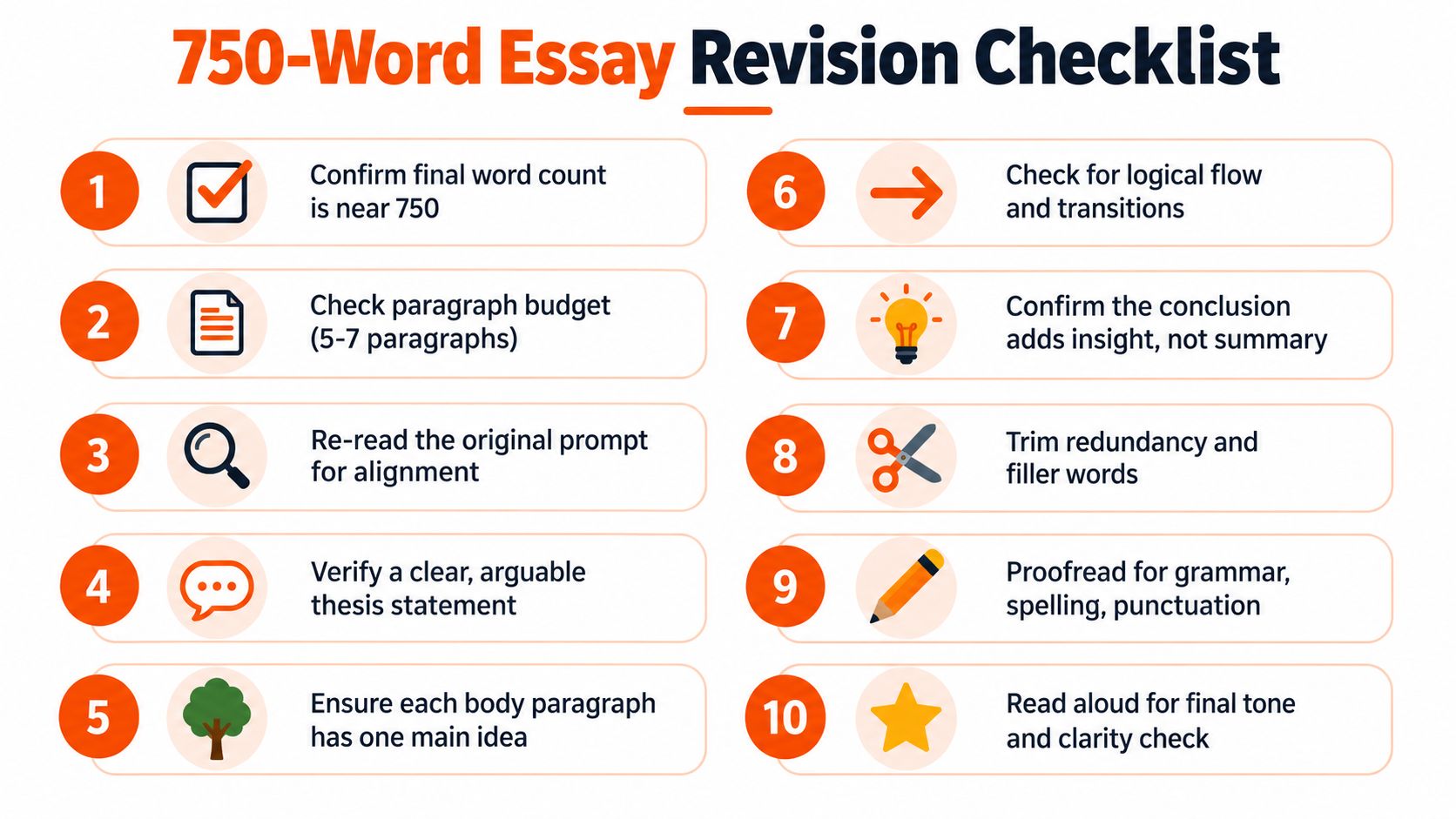
Revise in the order a reader experiences the paper. Surface polish can't rescue an essay that answers the wrong question, so check the argument before grammar.
- Confirm the word count. Check the required counting rules, including whether notes or bibliography are treated separately. The University of Otago advises staying within 10% of the required length, which would place a 750-word target between 675 and 825 words under that rule (University of Otago essay guidance).
- Check the paragraph budget. Make sure the introduction and conclusion haven't absorbed the body.
- Re-read the prompt. Mark any instruction your draft hasn't answered.
- Verify the thesis. It should be clear and arguable in the opening paragraph.
- Check each body paragraph. Each needs one main idea.
- Confirm the evidence. Every example should receive explanation.
- Tighten transitions. Keep transitions that show logic and remove those that merely announce another point.
- Test the conclusion. It should add a meaningful implication rather than repeat the body.
- Mark long sentences. Break any sentence over 30 words if its meaning becomes difficult to follow.
- Read aloud and spell-check. Listen for awkward rhythm, missing words, punctuation, and spelling errors.
Use one of these prompts to begin without staring at the blank page:
- Argumentative: Does the convenience of technology outweigh its effect on attention?
- Analytical: How does the writer use a setting to reveal a character's conflict?
- Comparative: Which text presents a more convincing idea of responsibility, and why?
- Reflective: What experience changed the way you understand a previously held belief?
- Evaluative: To what extent does the proposed solution address the problem?
A strong 750 word essay doesn't require every possible idea. It requires a deliberate claim, carefully selected support, and enough revision to make each sentence useful. Start with the budget, then let the argument decide what stays.
RewriteBar can help you polish selected sentences for grammar, clarity, tone, and concision while you work in any macOS app with text input. Visit RewriteBar to compare revisions side by side and refine your 750 word essay without leaving your writing flow.

More to read
How to Write Papers on a Mac: A Complete Workflow
Learn how to write papers on a Mac with this practical workflow covering apps, citations, templates, Mac productivity features, and final export for submission.
Research Paper Writing: A Practical Workflow for Better
Master research paper writing with a clear workflow covering topic selection, structure, citations, and editing. Includes tips for non-native speakers and AI
10 Essential Writing Tips for Students in 2026
Master your assignments with our top 10 writing tips for students. From outlining to proofreading, improve your essays and build confidence today.
Tags
Written by
Mathias MichelPublished
September 16, 2026