10 Resume Writing Tips to Win More Interviews
Use these resume writing tips to improve your headline, ATS keywords, achievements, formatting, examples, and final review for stronger applications.
Written by
 Mathias Michel
A qualified candidate can lose momentum before anyone understands their background. The resume is difficult to scan, the wording doesn't match the posting, and each bullet describes a duty instead of showing what changed because of the candidate's work. The problem isn't always a lack of experience. Often, the right evidence is buried.
Strong resume writing isn't about adding more content. It's about making the most relevant evidence easy to find, easy to understand, and credible enough to discuss in an interview. These resume writing tips follow a complete workflow, from positioning your value and selecting evidence to aligning keywords, formatting for applicant tracking systems, and checking the final file.
You'll also find practical examples for software developers, non-native English speakers, students, career changers, marketers, and founders. Use the process with an AI resume builder if you want help organizing a first draft, but keep ownership of every fact and claim. RewriteBar is another optional tool for polishing grammar, tone, and clarity in any text field. It can improve the wording, but you're responsible for making sure the content remains accurate.
1. Tailor Your Resume and Tone to Each Job, Company, and Audience
A generic resume asks the reader to do too much interpretation. A targeted resume makes the connection between your experience and the vacancy obvious. Start by copying the job description into a separate document, then mark the required skills, recurring phrases, responsibilities, and outcomes the employer emphasizes.
Your resume shouldn't repeat the posting mechanically. It should use the same professional language where that language accurately describes your experience. A software developer applying for a DevOps role might bring CI/CD pipelines, Docker, infrastructure automation, and deployment reliability closer to the top. The same developer applying for a product engineering position might lead with user-facing features, collaboration, and technical decision-making.
Change emphasis, not the truth
Tone should reflect the audience without turning into corporate theater. A startup may prefer direct language such as “Shipped a mobile product from concept to launch.” An enterprise finance employer may respond better to “Delivered a mobile application within a regulated operating environment.” Both versions can be accurate. Neither should claim experience the candidate doesn't have.
Research the company's website, product pages, job announcements, and public writing to understand its vocabulary. A non-native English speaker can use clear, professional phrasing for a formal industry while choosing more natural, conversational language for a startup. The facts stay the same.
Practical rule: Mirror the employer's terminology naturally, but never add a skill, tool, or responsibility simply because it appears in the posting.
Create separate versions for different target roles rather than forcing one document to serve every audience. A guide to role-based job discovery can help clarify which job families deserve different positioning. When you revise tone or phrasing, this guide to tone of voice in writing can help you keep the language consistent.
2. Use Action Verbs and Defensible Achievements
"Responsible for managing campaigns" tells a recruiter what appeared in your job description. It doesn't show what you did or why the work mattered. Replace duty statements with achievement statements that connect an action to a useful outcome.
A reliable formula is:
- Action: What did you change, build, lead, analyze, or improve?
- Context: For which customer, process, product, team, or business problem?
- Outcome: What became faster, clearer, safer, more reliable, or more useful?
For example, change “Managed social media accounts” to “Planned and published channel-specific content to support product launches and respond to audience questions.” The revised version is still honest without inventing a growth figure. If you have a verified result, add it. If you don't, describe the concrete output or improvement instead.
Choose verbs that describe the work
“Led” suggests ownership. “Automated” suggests a technical or process change. “Analyzed” suggests investigation. “Coordinated” suggests organization across people or tasks. Choose the verb that matches your actual contribution, and avoid using dramatic language for routine work.
A developer might write, “Implemented automated tests around a high-risk payment workflow and documented the release process.” A marketer might write, “Analyzed campaign data and used the findings to revise audience segments and creative briefs.” A student might write, “Built a research dashboard that helped a project team compare survey responses.”
Strong bullets also help non-native English speakers avoid vague phrasing. The active versus passive writing guide can help convert constructions such as “The report was prepared by me” into “Prepared the report for the project team.”
3. Optimize for Applicant Tracking Systems Without Writing for Robots
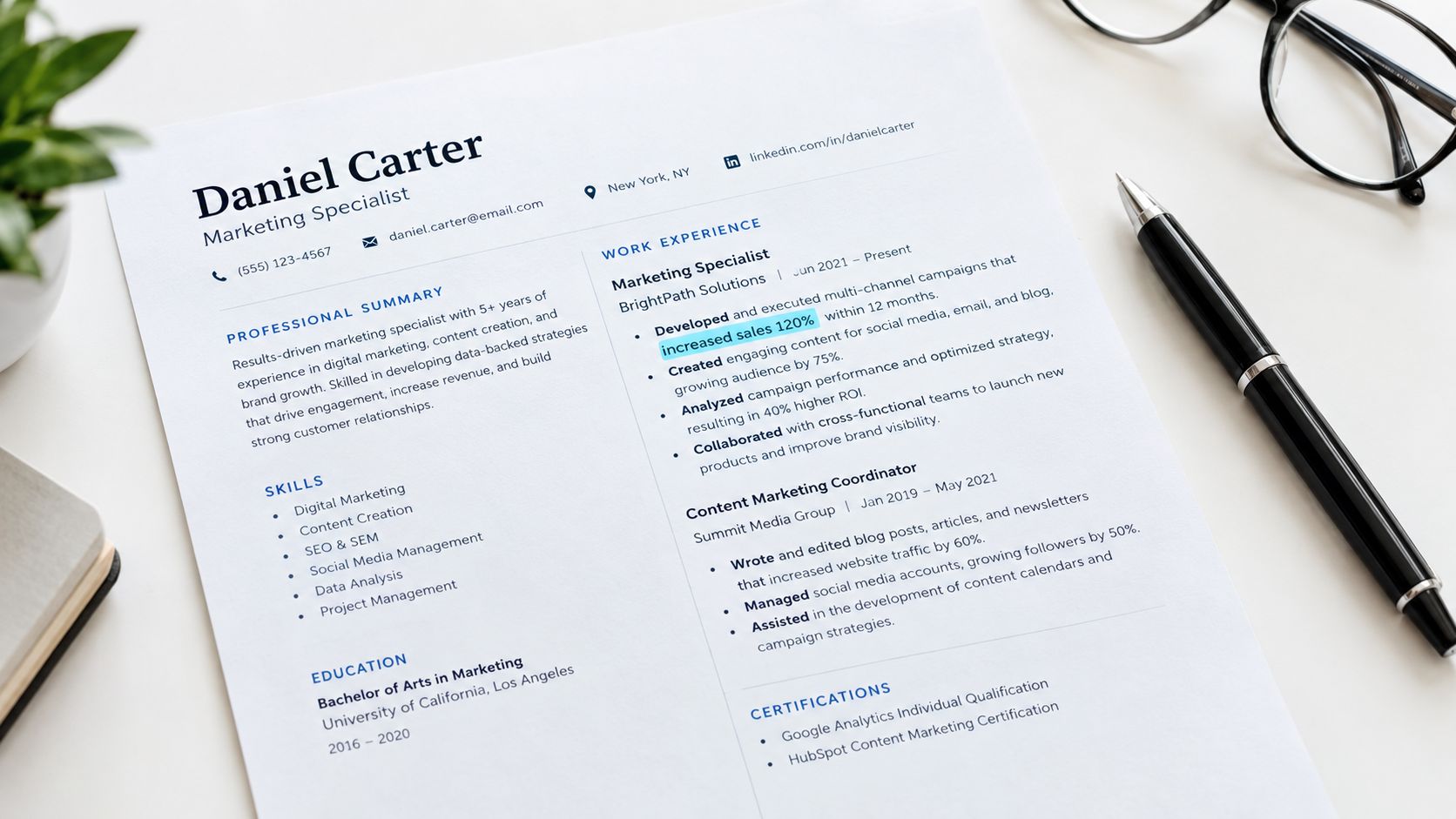
Applicant tracking systems are now a practical part of resume writing. A report on hiring among large companies stated that 97.8% of Fortune 500 companies used an ATS by 2025, while industry summaries estimate that roughly 75% of resumes are eliminated during screening before a human reviewer sees them. Those figures come from the resume statistics overview, and they explain why a visually impressive document can still fail before a recruiter reads it.
Use a structure that software can recognize and people can scan. Standard headings such as Summary, Experience, Skills, Education, Projects, and Certifications are safer than creative alternatives. Put important terms in ordinary text rather than hiding them inside graphics, icons, headers, footers, text boxes, or complicated tables.
Match the posting's language carefully
If the posting asks for Python, React, AWS, and Docker, list those technologies explicitly when you genuinely use them. Include a full certification name as well as a commonly used abbreviation when both are relevant. You might write “Machine Learning, ML” in a skills section, then demonstrate the skill in an experience bullet.
Don't stuff keywords into a dense block. Recruiters notice unnatural repetition, and an ATS-friendly resume still needs to make sense to a person. Use the required term in the summary, skills section, or experience section only where it fits the evidence.
A 2026 independent analysis reported a median first-submission ATS compatibility score of 52 out of 100, with 44% of resumes below 50 and 28% below 40. The same analysis reported that the average resume omitted 54% of keywords from the job description, which is why keyword alignment remains central to ATS resume writing.
Use a simple font, a single-column layout, and the file type requested by the employer. For more technical guidance, see this resource on how to write a tech resume for ATS.
<iframe width="100%" style="aspect-ratio: 16 / 9;" src="https://www.youtube.com/embed/0jQwXfsOds4" frameborder="0" allow="autoplay; encrypted-media" allowfullscreen></iframe>4. Create a Strong Professional Summary or Objective
The top of your resume should answer three questions quickly. What kind of professional are you? What evidence supports that positioning? What role or direction are you pursuing?
A summary works well when your experience already points toward the target role. An objective can be useful for a student, recent graduate, career changer, or founder moving into an operating role because the reader may not immediately understand the direction of the application.
Replace generic introductions
Weak summary: “Hardworking professional with excellent communication skills seeking a challenging opportunity.”
Stronger summary: “Full-stack engineer focused on building reliable web applications with React and Python. Experienced in working across product, design, and engineering teams, and seeking a role centered on scalable product development.”
The second version identifies a function, relevant tools, a working context, and a career direction. It doesn't rely on empty praise.
Keep the summary compact and adapt it for each application. Lead with the strongest differentiator, such as a specialized domain, relevant project type, transferable capability, or credential. A marketing analyst moving into UX research might emphasize user behavior analysis, research training, and experience turning findings into product decisions. A founder applying for a product leadership role might foreground user-centered strategy, team leadership, and experience taking products from idea to launch.
Don't turn the summary into a biography. It should create a clear frame for the evidence below, not repeat every skill in your resume. Read it beside the job description and remove any sentence that doesn't strengthen the match.
5. Prioritize Relevant Experience Over Chronological Completeness
A resume is a selection document, not an employment archive. Hiring teams need enough chronology to understand your background, but they don't need every task from every role given equal space.
Start by identifying the roles, projects, courses, volunteer activities, or freelance assignments that best support your target position. Give those experiences detailed bullets. Summarize less relevant work with a short description focused on transferable skills, progression, or context.
Curate without hiding information
A sales manager moving into product management might emphasize customer discovery, reporting, market analysis, and collaboration with product teams. Retail management can remain on the resume, but it may need less space if it doesn't support the new direction. A developer who completed a bootcamp can give detailed treatment to relevant projects and early engineering work, then briefly describe an unrelated earlier career.
Students don't need to apologize for limited full-time experience. Internships, university projects, volunteer work, student organizations, research, and freelance work can demonstrate planning, analysis, communication, or technical ability. Place the strongest evidence where a recruiter will find it, not where a rigid chronological template tells you to put it.
Career changers also need a clear timeline. Trying to conceal dates or compress an entire period into a vague skills section can create more questions. If you have an employment gap, use accurate dates and a concise label such as Career Break, Professional Development, Training, or Caregiving when appropriate. Guidance for 2026 emphasizes predictable structure, consistent dates, and honest labels rather than missing information, as explained in this employment gap resume guide.
The result should show a coherent story: what you did, what you learned, and why the relevant parts prepare you for this role.
6. Demonstrate Impact Through Project and Achievement Highlights
Projects give candidates a way to prove capability when job titles alone aren't enough. They work especially well for developers, students, founders, designers, researchers, and people changing careers.
Describe each project through a problem, an action, and an outcome. The outcome doesn't always need to be a percentage, revenue figure, or user count. It might be a working prototype, a faster process, a clearer decision, a documented system, a completed launch, or a portfolio artifact that someone can inspect.
Turn activities into evidence
Weak project description: “Worked on a mobile app with a team.”
Stronger project description: “Built the notification layer for a mobile app using an event-driven design, collaborated with the product team on user flows, and documented the deployment process for future contributors.”
The second version identifies ownership, technical context, collaboration, and an output. It gives an interviewer several points to explore.
A product manager might write, “Led discovery interviews, translated recurring user problems into requirements, and coordinated the launch of an analytics dashboard.” A student might write, “Designed a research project, cleaned the source data, and presented findings through a concise visual report.” A founder might write, “Built and launched a subscription product, handled customer feedback, and refined onboarding based on recurring questions.”
Select projects that reinforce the role rather than listing everything you've touched. For technical applications, name the relevant languages, frameworks, databases, or deployment tools. For confidential work, describe the industry, system, or business problem without disclosing protected information.
A project earns space when it proves something the job requires. If it only shows that you were busy, shorten it or remove it.
Use links to a portfolio, repository, published research, or product page when the material is professional, accessible, and relevant. The link should support the claim, not distract from it.
7. Maintain Clarity and Readability While Being Comprehensive
A resume has two reading modes. First, someone scans it for relevant titles, skills, dates, and evidence. Then, if the document survives that scan, the reader examines selected bullets in more detail. Your formatting needs to support both behaviors.
Historical eye-tracking research cited in later resume studies found that recruiters spent an average of 7.4 seconds on the first pass, while a survey of 418 hiring professionals found that 81% spent less than one minute reviewing a resume during initial screening. The findings and the related advice on front-loading skills and using clear headings are summarized in this recruiter screening research.
Use hierarchy instead of decoration
Make job titles, employer names, dates, and section headings easy to locate. Use bold selectively, keep bullet styles consistent, and leave enough white space between sections. A dense paragraph may contain good information, but a recruiter is less likely to find its strongest sentence during a quick scan.
A one-page resume can suit an early-career candidate, while an experienced professional may need more room for relevant evidence. Recent job-search reporting describes a shift toward resumes that are slightly longer and more complete, while still focused, with tighter summaries and shorter project descriptions. That guidance appears in the annual job search trends report.
Don't cut a relevant achievement merely to satisfy a universal one-page rule. Do cut repeated responsibilities, outdated tools, unrelated detail, and long explanations that belong in an interview.
8. Strategically Highlight Technical Skills and Certifications
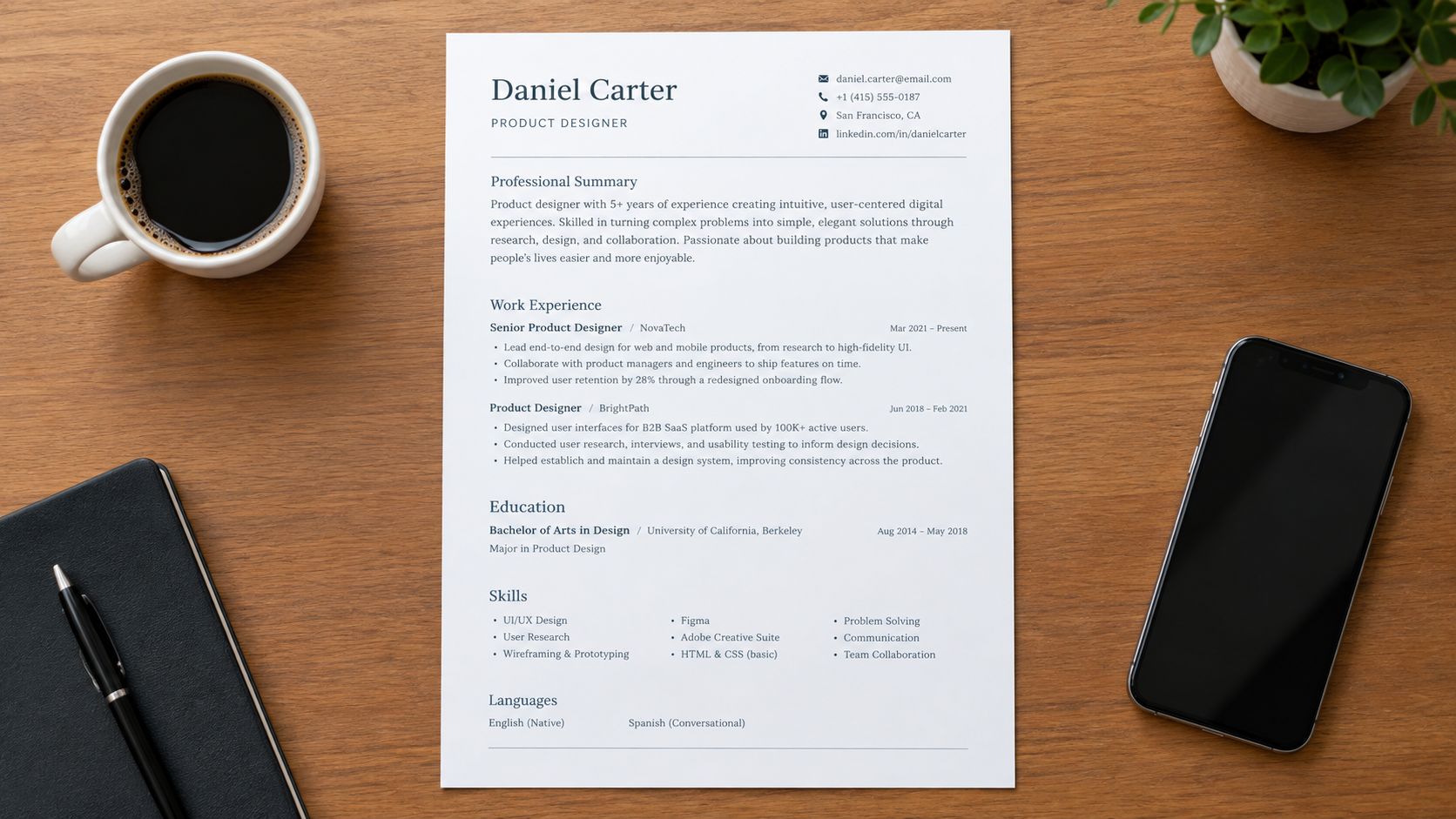
A skills section should help a recruiter find relevant capabilities quickly, then give the experience section a chance to prove them. Avoid a long, undifferentiated list that treats a current strength, an old tool, and a passing familiarity as equivalent.
Group technical skills into categories that match your field. A developer might use Languages, Frameworks, Databases, Cloud and DevOps, Testing, and Tools. A data professional might separate languages, libraries, platforms, visualization tools, and certifications. A marketer might organize skills around analytics, automation, content systems, advertising platforms, and research methods.
List what you can defend
Use the exact spelling from the job posting when it accurately reflects your experience. Include both a platform and a relevant component when the distinction matters, such as AWS with the services you have used, or CI/CD with the automation tool that supports it.
A concise example might look like this:
- Languages: Python, JavaScript, SQL
- Frameworks: React, FastAPI
- Cloud and DevOps: AWS, Docker, GitHub Actions
- Data: PostgreSQL, Pandas
- Certifications: Full official certification name
Don't use progress bars or star ratings. They consume space, aren't reliable evidence, and can be difficult for ATS software to interpret. Don't list every tool you've opened once. If you couldn't explain how you used a technology, it probably doesn't belong near the top of the section.
Certifications deserve the same discipline. Include the official name, issuing organization, and relevant date when the credential strengthens the application. A certification that has expired, doesn't relate to the role, or appears without supporting experience may add clutter rather than credibility.
Finally, repeat the most important technical skills in relevant experience bullets. A skills list says you know a tool. A project or achievement bullet shows how you applied it.
9. Proofread Meticulously and Test Quality Across Formats
A resume can fail for reasons unrelated to experience. A misplaced date, inconsistent tense, broken hyperlink, missing word, or corrupted export can make a careful candidate appear careless.
Proofreading should happen in passes. First check the facts, including names, dates, job titles, contact details, technologies, certifications, and links. Next check the writing for grammar, tense, repetition, and clarity. Then inspect the visual file rather than assuming the source document exported correctly.
Review the document like a stranger
Read the resume aloud. Your ear may catch a missing article or awkward sentence that your eyes have learned to ignore. Print it or view it at normal size on another device. Check that bullets align, headings remain with the content beneath them, and no page ends with a stranded line.
Watch for small errors that change meaning:
- Plural and possessive forms: “Developers” is not the same as “developer's.”
- Verb tense: Use past tense for completed roles and present tense for current work.
- Date consistency: Use one format for every role and education entry.
- Technology names: Check capitalization for tools, languages, platforms, and certifications.
- File identity: Confirm that the exported document belongs to the intended candidate and role.
Spell-check tools are useful but incomplete. They won't reliably identify a technically valid word used in the wrong context, and they won't know whether a result is accurate. A grammar and proofreading checklist can add structure to the final review.
Open the actual file you'll submit in the applications and programs you commonly use. Check both PDF and DOCX when the employer's instructions permit or require different formats. Save the inspected version with a clear filename that identifies you and the target role.
10. Keep Your Resume Updated and Maintain a Master Version
The easiest time to record an achievement is shortly after you complete the work. Waiting until an application appears forces you to reconstruct projects, tools, decisions, and outcomes from memory.
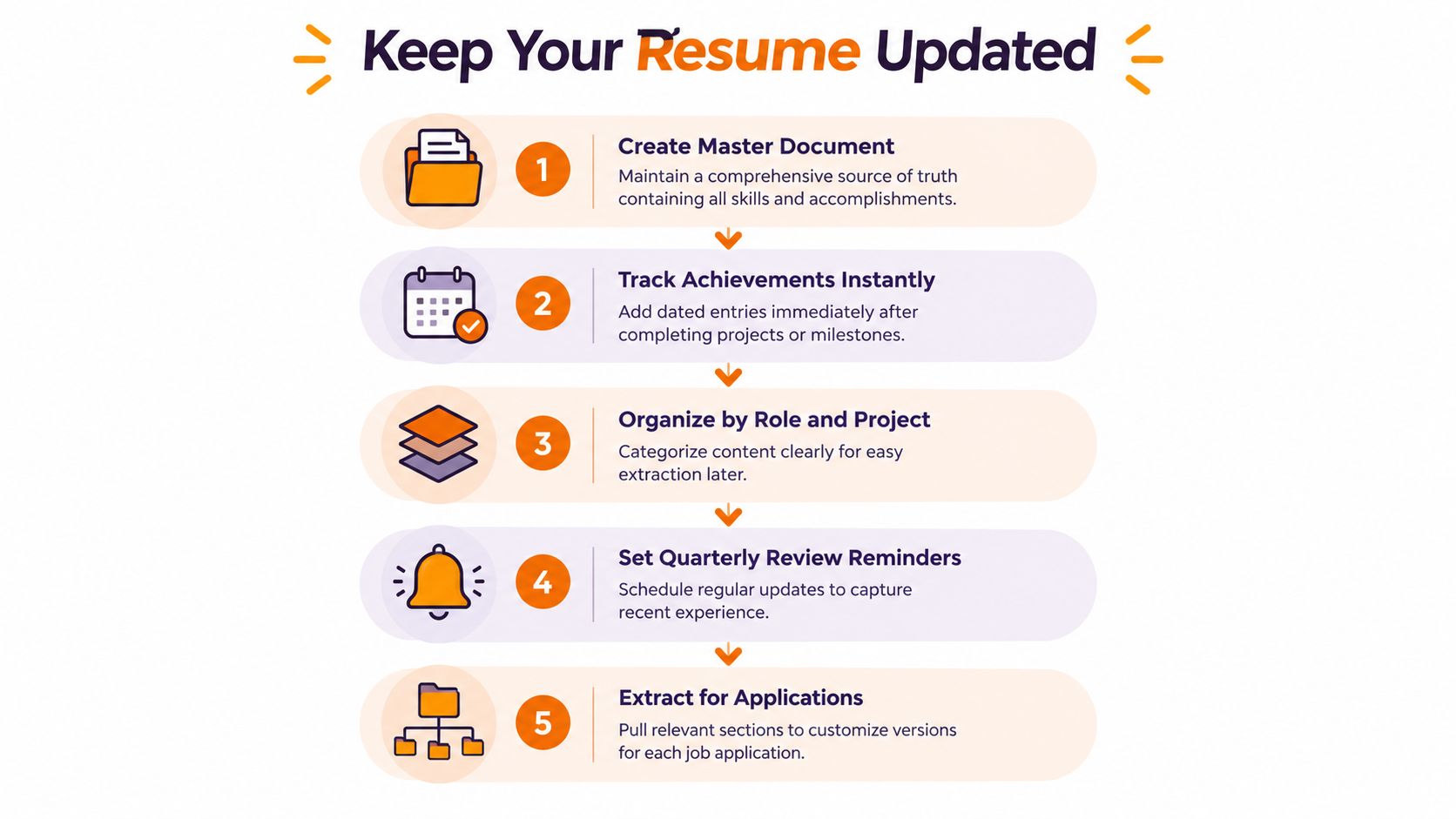
Maintain a master resume as a private source document. It can contain more detail than any submitted version, including every relevant role, project, technology, certification, accomplishment, and transferable skill. The master is not meant to be sent unchanged. It's the inventory from which you select evidence.
Build a repeatable versioning habit
After a major project, add a dated entry to the master file. Record the problem, your contribution, the tools involved, collaborators, and the result. If a metric is available, record where it came from so you can defend it later. If the work is confidential, note a safe public description.
For an application, duplicate the master document and rename the copy for the role. Reorder the summary, skills, projects, and experience bullets to match the posting. Keep completed applications in dated folders so you can remember which version you submitted and how you described your background.
A master file also helps different audiences. A developer can pull technical work into job applications and keep a separate project inventory for a portfolio. A founder can adapt company milestones and operating experience for a product role without rewriting the entire career history. A student can maintain coursework, research, volunteer work, and project notes until stronger professional experience replaces them.
Top 10 Resume Writing Tips Comparison
| Strategy | 🔄 Implementation Complexity | ⚡ Resource Requirements | ⭐📊 Expected Outcomes | Ideal Use Cases | 💡 Key Advantages |
|---|---|---|---|---|---|
| Tailor Your Resume and Tone to Each Job, Company, and Audience | High, requires role/company research and wording adjustments | Moderate–High time investment; templates reduce effort | Higher ATS pass & interview callbacks; better cultural fit ⭐📊 | Mid‑senior roles, competitive positions, differing company cultures | Direct alignment with job requirements; more relatable to hiring managers 💡 |
| Use Action Verbs and Quantifiable Achievements | Low–Moderate, rewrite bullets into impact statements | Requires metric collection and verification | Clearer impact; stronger credibility and memorability ⭐📊 | Performance‑driven roles (sales, marketing, engineering) and all levels | Makes contributions measurable and defensible in interviews 💡 |
| Optimize for Applicant Tracking Systems (ATS) | Moderate, needs format and keyword know‑how | Low tools; attention to formatting and keyword research ⚡ | Increased chance to reach human reviewers; better screening pass rates ⭐📊 | Large companies, automated hiring pipelines, tech roles | Simple changes yield large improvements in screening success 💡 |
| Create a Strong Professional Summary or Objective | Moderate, concise crafting and iteration required | Low time; multiple drafts/testing | Quick clarity on fit; differentiates candidates at glance ⭐📊 | Career changers, new graduates, non‑linear backgrounds | Sets context and priorities for the rest of the resume 💡 |
| Prioritize Relevant Experience Over Chronological Completeness | Moderate, judgment calls on relevance and omission | Time to curate and reformat per application | Focused presentation of strengths; shorter, higher‑impact resume ⭐📊 | Career transitions, applicants with varied histories | Emphasizes qualifications that matter most to the role 💡 |
| Demonstrate Impact Through Project and Achievement Highlights | Moderate, needs clear problem→solution→outcome framing | Requires project records; may need anonymization | Concrete evidence of capability; strong interview talking points ⭐📊 | Product, engineering, PM, founders, technical roles | Translates abstract skills into tangible business outcomes 💡 |
| Maintain Clarity and Readability While Being Comprehensive | Moderate, iterative formatting and editing | Formatting tools and review cycles; multiple device tests | Better scanability and full‑read likelihood; professional appearance ⭐📊 | All resumes, especially roles reviewed quickly by hiring managers | Balances scannability with depth; improves both human and ATS reads 💡 |
| Strategically Highlight Technical Skills and Certifications | Low, list curation and categorization | Low maintenance; periodic updates required ⚡ | Immediate technical credibility; improves keyword matching ⭐📊 | Engineers, data scientists, cloud/devops and cert‑driven roles | Enables quick skill‑matching and interview qualification 💡 |
| Proofread Meticulously and Test for Quality Across Formats | Low–Moderate, multiple passes and methods | Time, external reviewers, format testing tools | Reduces disqualifying errors; preserves professional credibility ⭐📊 | All submissions; essential for writing‑intensive roles | Eliminates avoidable rejections and builds confidence in submission 💡 |
| Keep Your Resume Updated and Maintain a Master Version | Low, ongoing maintenance routine | Time discipline; cloud storage/version control ⚡ | Faster customization; fewer forgotten achievements; consistent history ⭐📊 | Active jobseekers, frequent applicants, career builders | Source‑of‑truth enables rapid, accurate tailored resumes 💡 |
Turn the Checklist Into Your Next Application
A strong resume comes from a sequence of decisions, not from one last burst of formatting. Start with the target posting and identify the role's priorities, recurring terminology, required tools, credentials, and type of evidence. Compare those requirements with your master resume and decide which experience deserves the most space.
Then sharpen the headline and summary. Make the target role clear, name the strongest differentiator, and remove language that could apply to anyone. Review every experience bullet and replace duties with actions, context, and defensible outcomes. If you don't have a numeric result, use a concrete output or describe the improvement without inventing a figure.
Next, verify keyword alignment. Check that relevant skills appear in ordinary text, that job titles and certifications use accurate language, and that the resume doesn't rely on images or decorative elements to communicate important information. Recruiters rely heavily on ATS filters. A 2026 industry summary reported that 99.7% of recruiters use filters in their ATS, with the most common filters being skills at 76.4%, education at 59.7%, job titles at 55.3%, and certifications or licenses at 50.6%. Those findings are detailed in this ATS filtering analysis, and they support a practical priority: surface the qualifications the posting asks for.
Then inspect the format. Use standard headings, a readable single-column layout, consistent spacing, and the file type requested by the employer. Don't force the document onto one page if doing so removes relevant evidence. Do remove repetition, outdated detail, and unrelated history. For employment gaps or a nonlinear background, use accurate dates and concise context instead of hiding information.
Before submission, run a language pass. Check grammar, spelling, tense, tone, and clarity. AI assistants such as RewriteBar can polish a summary, compare versions, translate text, or run a custom workflow. RewriteBar works in any app with text input and can provide grammar and clarity suggestions, but it must remain an editing aid. Review every suggested keyword, metric, technology, job duty, and achievement for truth and relevance. AI should never fill an evidence gap with an invented claim.
Use this reusable sequence for each application:
- Positioning: Write a headline and summary that fit the target role.
- Evidence: Select relevant achievements, projects, coursework, and transferable skills.
- Achievement bullets: Start with accurate action verbs and explain the result or output.
- ATS check: Confirm standard headings, natural keyword alignment, readable formatting, and the requested file type.
- Role adaptation: Adjust emphasis and tone for the company, industry, and audience.
- Final proof: Review facts, language, links, dates, page breaks, and the exported file.
- Version control: Save the customized resume beside the master version with a clear filename.
The final question isn't whether the resume contains everything you've done. It's whether the reader can quickly see why your evidence fits this particular job.
RewriteBar can polish resume summaries, achievement bullets, grammar, tone, and clarity directly in the apps where you write. Use RewriteBar to compare versions or build a repeatable editing workflow, then review every change before you submit.

More to read
Project Documentation: A Practical Guide for Modern Teams
Learn what project documentation is, the types that matter, and best practices for keeping it useful across software, research, and product teams.
How to Write Professionally: Your 2026 Guide
Master how to write professionally. This 2026 guide covers tone, structure for emails, reports, grammar, & tools to boost your clarity & impact.
Professional Communication Skills That Actually Work
Build professional communication skills that get results at work. Clear frameworks, real examples, and practical exercises for every situation.
Tags
Written by
Mathias MichelPublished
October 4, 2026