How Readability Scoring Actually Works
Discover how readability scoring works, why legacy formulas fail, and how to use AI tools like RewriteBar to write clearer content for any audience.
Written by
 Mathias Michel
The most popular advice about readability scoring is also the most misleading: get the score down, and your readers will understand the content. That sounds practical, but a formula can't tell whether a reader recognizes a term, follows an argument, or understands what to do next.
Readability scores remain useful as diagnostic signals. They can expose sentences that carry too many clauses or wording that creates unnecessary friction. They become dangerous when writers treat a single number as a verdict on comprehension. A modern workflow uses the score to find possible problems, then uses structural editing, audience knowledge, and AI-assisted review to decide what to change.
The Readability Scoring Illusion
A high Flesch Reading Ease score can coexist with confusing content. A short sentence may contain an undefined acronym, a misleading transition, or a conclusion that doesn't follow from the evidence. Conversely, a technically dense sentence may be appropriate when the audience already understands the terminology.
The Agency for Healthcare Research and Quality makes this limitation explicit. Its guidance explains that readability formulas mainly use average word and sentence length, can't determine whether words are familiar, and don't measure comprehension or reading ease. That matters in health, education, and public-facing web content, where understanding depends on context as much as vocabulary. Read the AHRQ guidance on the limits of readability formulas for the underlying distinction.
Practical rule: Treat a readability score as a smoke alarm, not a comprehension test.
Recent research makes the gap harder to dismiss. A 2025 EMNLP paper found that 6 of 8 readability metrics had poor correlation with human judgments, with Pearson correlation below 0.3 for several measures, including Flesch-Kincaid Grade Level. Those findings don't make formulas useless. They show that formula-based scores are weak proxies for how people judge plain-language readability. The result is especially relevant when teams set rigid grade-level targets without testing whether readers can complete the intended task.
Why score chasing damages good writing
Blind optimization encourages predictable distortions:
- Fragmented sentences: Writers split connected ideas into choppy units merely to lower average sentence length.
- Vocabulary substitution: Editors replace precise technical terms with vague alternatives that score better but communicate less.
- Missing relationships: A text may contain simple words while failing to explain cause, sequence, contrast, or consequence.
- Audience mismatch: Specialists may find an artificially simplified explanation patronizing, while general readers may still struggle with the underlying concept.
Consider a software explanation that says, “The system checks your data. It creates a result. You can use the result.” The wording is simple, but the reader still doesn't know what data is checked, why the result matters, or what action follows. The score might improve while the explanation gets worse.
What the number can still reveal
Formula-based feedback becomes valuable when you inspect the text behind it. A low score may point to long sentences, dense wording, or a paragraph that needs restructuring. It doesn't tell you which edit is correct, so the writer must evaluate the flagged passage against the reader's goal.
A practical review asks three questions:
- Can the reader identify the main point quickly?
- Can the reader follow the relationship between ideas?
- Can the reader act without guessing?
If the answer to any question is no, lowering the score alone won't solve the problem.
How Legacy Formulas Calculate Text Difficulty
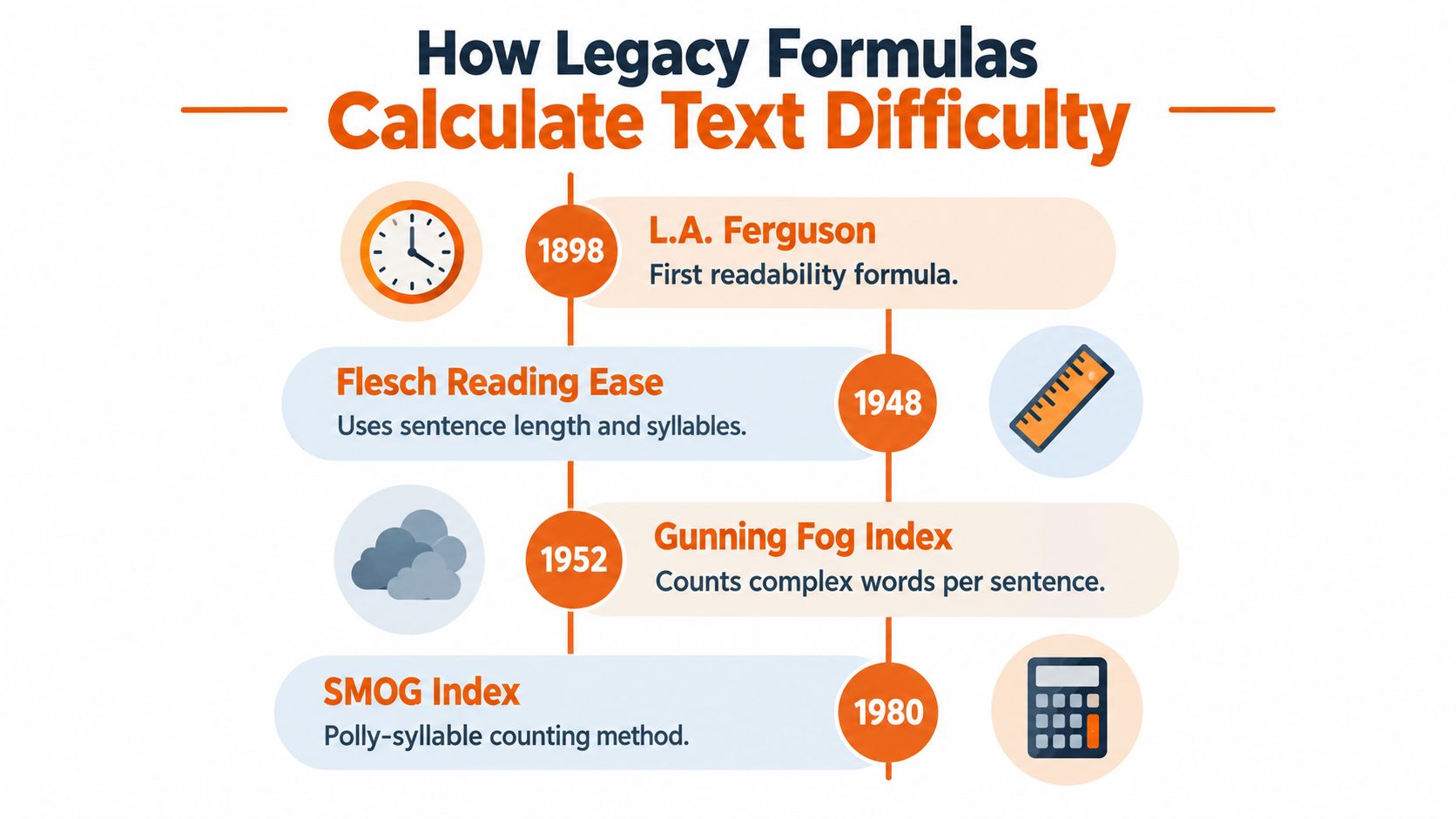
Readability scoring has a long history. Formal readability measurement dates back to the 1920s, and one early formula was created by B. Lively and S. L. Pressey in 1923. Later work by Rudolph Flesch became the most widely cited foundation. His Reading Ease formula appeared in 1948 and offered a practical way to estimate text difficulty from features that could be counted consistently. The history and mechanics of readability formulas provide useful background.
The inputs are deliberately simple
The Flesch Reading Ease formula uses only two measurable features:
- Average sentence length, usually calculated from the number of words divided by the number of sentences.
- Average syllables per word, which estimates word complexity through pronunciation.
The result appears on a 0-to-100 scale. A score near 0 is associated with very difficult text, while 100 is associated with very easy text. In the standard interpretation, a score around 30 indicates very difficult material, and a score around 70 is considered suitable for adult audiences.
Those values are useful orientation points, not universal publishing rules. A formula can distinguish a short, plain sentence from a long, polysyllabic one. It can't identify whether the sentence answers the reader's question or whether the writer has chosen the right level of detail.
Flesch-Kincaid Grade Level uses the same general inputs but expresses the result as an estimated U.S. school grade level. Other legacy formulas use related surface features. The important point is that these systems don't read for meaning. They count characteristics of the text.
Why the formulas became influential
Their simplicity was an advantage. Publishers, educators, public agencies, and mass communicators could apply the same type of measurement without assembling a panel of readers for every draft. Sentence length and syllable count were practical signals at a time when large-scale content assessment needed to be relatively mechanical.
That practicality still explains why readability scoring appears in word processors, editorial platforms, and SEO tools. A number is easy to compare across drafts, and a highlighted long sentence gives an editor an immediate place to begin.
A formula can identify linguistic friction. It can't decide whether removing that friction would remove necessary meaning.
The false positive is common in technical writing. A domain-specific word may contain several syllables but be far clearer to the intended audience than a vague, shorter phrase. “Authentication” may be more useful to a developer than “checking who you are,” even if the latter scores as easier. The correct edit depends on the reader's vocabulary and the task, not on syllable count alone.
The Shift to Multi-Dimensional AI Assessment
The field is moving away from the idea that one grade-level number can represent every aspect of readability. A 2026 ACL workshop paper proposed evaluating readability across multiple subjective dimensions instead of relying on one score. That approach reflects how human readers experience text. They assess clarity, coherence, familiarity, flow, and effort together, even when they don't name those dimensions.
A separate 2026 study found that combining zero-shot LLM judgments with classical formula scores outperformed readability formulas on all 14 datasets and standalone LLMs on 11 datasets, with especially strong gains on non-English datasets. These results support a hybrid approach rather than a total replacement of traditional metrics. The research appears in the ACL Readability workshop volume.
Compare the methods
| Feature | Legacy Formulas, Flesch-Kincaid | AI / LLM Assessment |
|---|---|---|
| Primary input | Sentence length and syllable patterns | Meaning, context, organization, wording, and audience instructions |
| Output | A score or estimated grade level | Explanations, flagged passages, rewrite options, and qualitative judgments |
| Strength | Fast, consistent, and easy to compare | Sensitive to context, logic, terminology, and reader intent |
| Blind spot | Doesn't measure comprehension or conceptual flow | Can make inconsistent judgments or remove needed nuance |
| Best use | Triage and trend monitoring | Diagnosis, revision, and audience-specific review |
| Human oversight | Essential for interpreting the score | Essential for checking accuracy and preserving the author's intent |
When each method earns trust
Use a legacy formula when you need a quick baseline. It's helpful for spotting a sudden rise in sentence or word complexity across a content series, especially when the audience and format remain stable. It also gives editors a shared language for discussing surface-level difficulty.
Use an LLM assessment when the problem may involve meaning rather than mechanics. Ask it to identify undefined terms, weak transitions, buried conclusions, unclear references, missing steps, or conflicting claims. Then require it to explain why each passage might challenge the specified audience.
AI assessment works best with a precise brief. Instead of asking, “Make this easier,” specify:
- Who will read it.
- What the reader already knows.
- What the reader must understand or do.
- Which technical terms must remain.
- Whether the tone should stay formal, concise, or conversational.
- Whether the model should suggest edits or only diagnose problems.
Writers who use AI editing should also understand the difference between generation and controlled transformation. This overview of AI writing offers useful context for evaluating where an assistant fits in the editorial process.
Practical Techniques for Genuine Clarity
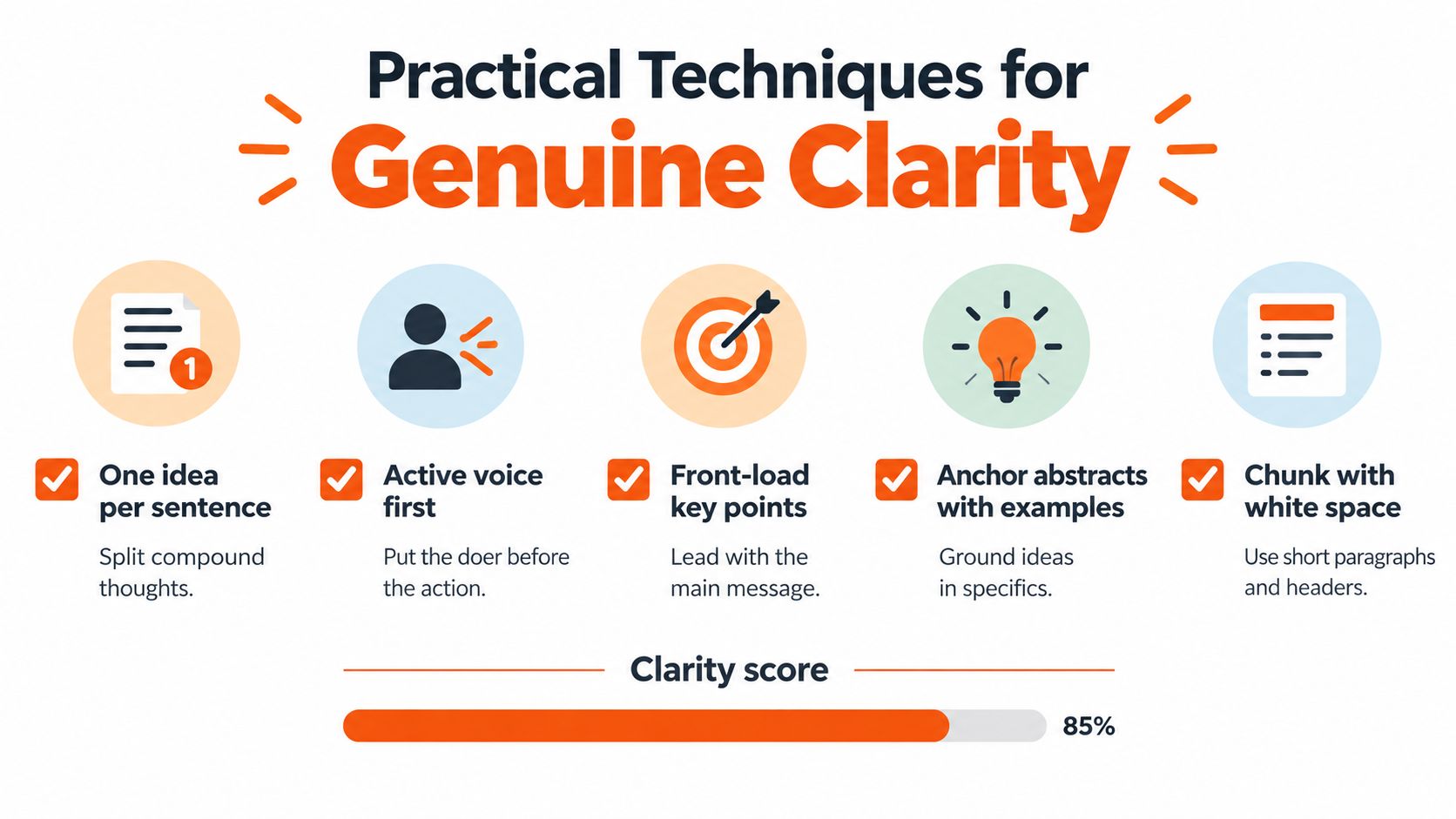
Clarity improves when the reader can build a mental model without unnecessary effort. Shorter sentences help, but they're only one part of the job. The strongest edits clarify the order of ideas, expose the actor in each action, and give abstract claims a concrete reference.
Start with the reader's destination
Front-load the answer before the explanation. If the reader needs to know whether a process is possible, state the answer first. Follow with the conditions, exceptions, and reasoning.
Weak structure:
The platform supports several workflows, each of which can be configured according to the requirements of different teams. Depending on the workflow selected, users may be able to process the content in different ways.
Clearer structure:
You can process the content through three workflow types. Choose the type that matches your review goal.
The second version doesn't merely use shorter sentences. It gives the reader a stable frame before adding detail.
Make actions visible
Active voice often improves clarity because it puts the doer before the action. “The editor reviewed the draft” tells the reader who acted. “The draft was reviewed” hides that information, which may matter if responsibility or sequence is important.
Don't force active voice where it creates an unnatural sentence or removes useful emphasis. Use it as a default, then preserve passive voice when the action matters more than the actor.
Give abstract ideas an anchor
Technical terms carry meaning only when readers can connect them to an example. After introducing a concept such as semantic ambiguity, show the ambiguity in a sentence. After describing a workflow, demonstrate the input and output. Examples reduce the distance between definition and application.
Useful anchors include:
- A short before-and-after sentence.
- A miniature scenario involving the target reader.
- A list of observable signals.
- A concrete consequence of getting the decision wrong.
Design for scanning
Paragraph shape, headings, lists, and white space affect how readers enter a page. A well-organized article lets a busy reader locate the answer, then choose whether to read the explanation. That visual structure won't appear in a Flesch score, but it changes the reading experience.
Use a list when readers need to compare items or follow steps. Keep related reasoning in prose when the relationship between ideas matters. For a deeper treatment of clear phrasing and structure, see this guide to clarity in writing.
Keyword discipline matters here too. Repeating a target phrase until the prose sounds unnatural creates friction rather than relevance. StoryCV's guide to avoiding keyword stuffing is a useful resource when you're balancing search intent with natural language.
Read the draft aloud before publishing. Your ear catches false starts, overloaded clauses, and abrupt transitions that a formula can't see.
<iframe width="100%" style="aspect-ratio: 16 / 9;" src="https://www.youtube.com/embed/wcgTLm5-L4o" frameborder="0" allow="autoplay; encrypted-media" allowfullscreen></iframe>Integrating AI Tools into Your Writing Workflow
AI becomes useful for readability when it sits inside a repeatable editorial loop. The goal isn't to hand over authorship. It's to reduce the time between spotting a clarity problem and testing a better version.
Start with a real passage, not an abstract instruction. Suppose a developer has written a product explanation in a code editor, email client, or document app. The draft contains accurate terminology, but the main action appears at the end, several sentences contain nested conditions, and a non-native English speaker may interpret one phrase in more than one way.
Capture the passage without changing context
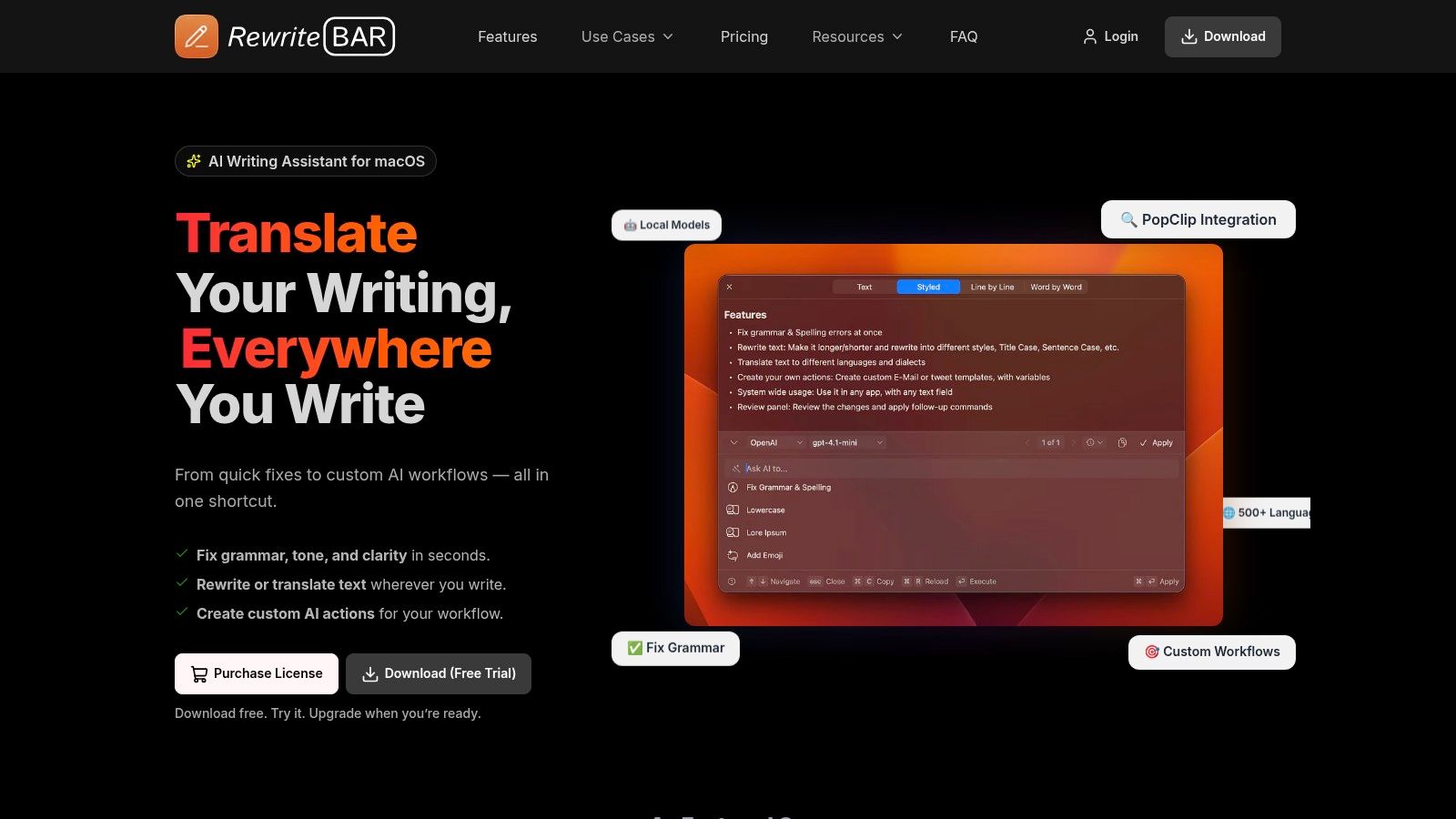
A menu-bar assistant such as RewriteBar can capture selected text from the active macOS application through a keyboard shortcut. The writer doesn't need to copy the passage into a separate browser tab, create a temporary prompt, or interrupt the drafting flow.
The first action should diagnose rather than rewrite:
Identify the main claim, the intended reader, missing context, ambiguous references, and sentences that carry multiple ideas. Preserve all technical facts.
That prompt gives the model a constrained job. It asks for editorial evidence before requesting stylistic changes.
Chain diagnosis with controlled revision
Once the problems are visible, run a second action:
Rewrite for software users who understand the product category but may not know this implementation detail. Keep the technical terms authentication, token, and session. Put the action in the first sentence. Use active voice where it improves clarity. Don't remove warnings or conditions.
Then compare the original and revision side by side. Look for meaning loss, not just a higher score. Did the model remove an exception? Did it turn a precise term into a vague one? Did it change who performs an action?
A third pass can check the revision against the original:
List every factual, procedural, or technical change between these versions. Mark any change that could alter the reader's decision.
This chain is more reliable than a single request to “make it readable.” The writer controls the audience, constraints, and review criteria while the model handles pattern detection and alternative phrasing.
Keep privacy and consistency in the workflow
Teams should decide where text may be processed before adopting an AI assistant. Cloud providers can be convenient, while local options may suit drafts containing confidential material. The right configuration depends on the organization's policy, the sensitivity of the text, and the quality required from the model.
For direct simplification tasks, a focused language simplification tool can be useful when the writer has already decided which terms must remain. The final review still belongs to the subject-matter owner. Readability tools can propose language, but they can't accept responsibility for the accuracy of a specification, medical explanation, contract, or public claim.
Common Readability Questions and Misconceptions
What score should a writer target?
There isn't one correct target for every audience. A consumer explainer, developer reference, academic paper, and legal notice have different readers, purposes, and vocabulary expectations. A lower grade-level estimate may suit an introductory page, while a specialist document may need terms that increase the score.
Set a target range only after defining the reader and task. Then use the score to detect outliers, not to force every passage into the same shape. A paragraph explaining a basic action may deserve simpler language than a paragraph defining a technical constraint in the same document.
Does a lower grade level mean better writing?
No. Lower complexity can improve access, but oversimplification can reduce precision. The best sentence uses the clearest accurate wording available for its audience, even when that wording includes a specialized term.
Replace a difficult word when it adds status rather than meaning. Keep it when the term names a concept the reader needs. If you retain it, define it at first use or connect it to an example.
Do formulas penalize technical terminology?
They can. Syllable-based systems treat many long technical words as evidence of difficulty, even when those words are familiar to the intended audience. That's why a developer guide can produce a lower ease score without being poorly written for developers.
Review each flagged term in context:
- Keep it when it names a necessary concept.
- Define it when the audience may encounter it for the first time.
- Replace it when a shorter, equally precise term exists.
- Move it when it interrupts the main action and belongs in a note or reference.
Can AI decide whether text is comprehensible?
AI can offer a more context-sensitive judgment than a formula, especially when you provide an audience and task. It can inspect coherence, implied knowledge, transitions, and ambiguity. It can still misunderstand the domain, accept a false premise, or recommend a fluent but inaccurate rewrite.
Use AI as a second reader with a structured brief. Combine its explanation with formula-based signals, human review, and feedback from actual users when the stakes justify it. No automated score should replace testing whether readers can find, understand, and apply the information.
Building a Sustainable Clarity Practice
Readability scoring works best as part of an editorial system. Run a formula after drafting to locate surface-level friction. Use AI to inspect meaning, structure, audience fit, and ambiguity. Then make the final decision as a writer who understands the subject and the reader.
A durable practice includes a small set of repeatable checks:
- Audience check: Name the reader and the action the content should support.
- Structure check: Put the main answer first and give each paragraph one job.
- Language check: Remove needless complexity while preserving essential terminology.
- Formula check: Investigate unusual scores instead of chasing a universal number.
- Human check: Read aloud, ask a colleague to explain the passage, or observe where users hesitate.
The central shift is simple. Readability scoring is a starting point for refinement, not the final judge of quality. Legacy formulas still provide fast, consistent signals. AI can add contextual analysis and targeted alternatives. Writers create the result by deciding what the audience must understand and protecting that meaning through every edit.
Use RewriteBar to capture text from any macOS app, run grammar, tone, simplification, and custom clarity workflows, and compare revisions without leaving your writing environment. Visit RewriteBar to build a practical readability review process around the tools and AI providers that fit your work.

More to read
8 Paraphrasing Techniques for Clearer Writing
Learn 8 paraphrasing techniques with before-and-after examples, practical use cases, pitfalls, and AI-assisted workflows for clearer writing.
How to Use AI for Writing (2026 Practical Workflow)
Learn how to use AI for writing with a step-by-step workflow covering prompt templates, editing, privacy options, and ready-to-use examples for every task.
Grammarly Alternative for Mac: Best Picks for 2026
Looking for a Grammarly alternative for Mac? Compare the best options for grammar, tone, privacy, offline use, integrations, and pricing in 2026.
Tags
Written by
Mathias MichelPublished
September 26, 2026